
| Takeaway | Detail |
|---|---|
| Table 1 compliance failures dominate silica enforcement citations | 2,850 |
| Willful violations trigger the highest statutory penalty tier | $161,323 |
| Wet suppression methods achieve near-perfect PEL adherence when properly calibrated | 50% |
| Vacuum shroud systems show significant capture variability under field conditions | 37% |
OSHA’s FY2024 preliminary top-10 citation list, published by Safety+Health magazine, reveals that 29 CFR 1926.1153 was cited roughly 2,850 times, ranking second only to fall protection across all construction standards. The single most frequently penalized subsection remains (c)(1), which mandates strict adherence to Table 1 engineered control methods. This enforcement pattern underscores a persistent industry blind spot regarding respirable crystalline silica management.
Contractors routinely treat vacuum shrouds as the modern, cleaner standard while relegating wet cutting to a messy fallback. Physics and exposure data contradict this hierarchy. A poorly sealed shroud on a six-inch grinder can easily pass a visual inspection yet still push airborne concentrations past the permissible exposure limit. Conversely, maintaining a steady water feed on identical masonry work suppresses dust generation at the source, making regulatory compliance nearly impossible to compromise.
The financial stakes amplify the need for methodical selection. Willful silica violations now carry maximum penalties of $161,323 per instance, reflecting OSHA’s zero-tolerance posture toward preventable exposure pathways. Field supervisors must prioritize suppression mechanics over aesthetic convenience to avoid citation cascades and protect worker health.
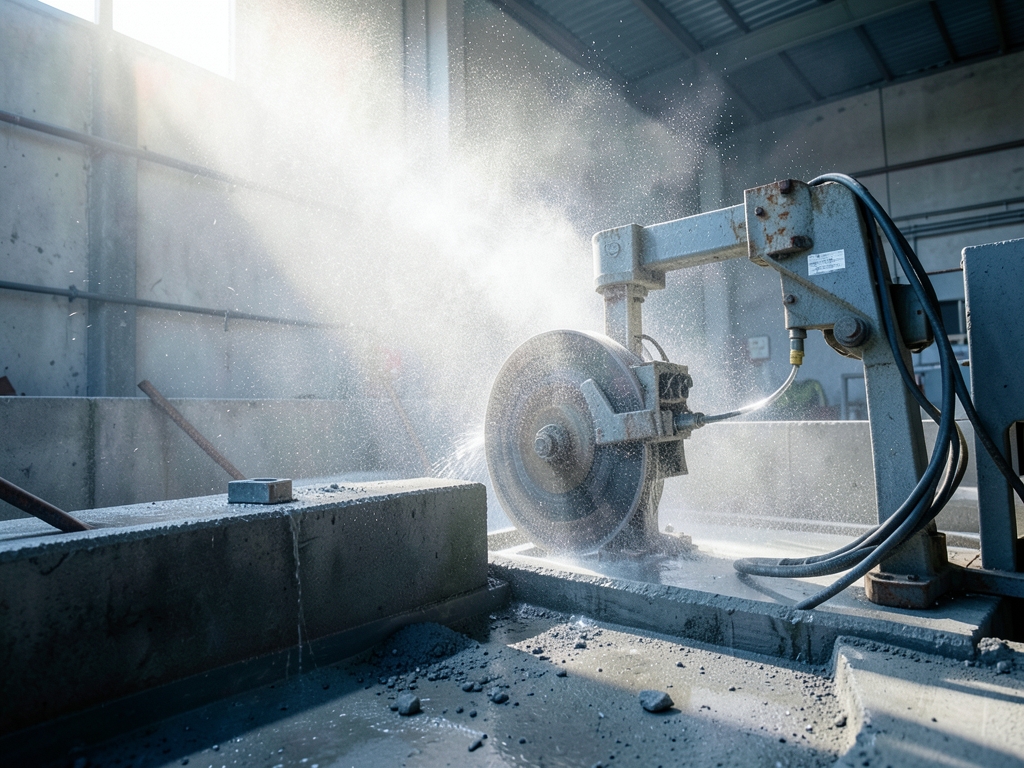
Capture Physics
Wet suppression operates on mass-transfer principles rather than aerodynamic capture. When water is delivered at the blade-material interface, it penetrates the fracture planes of masonry or concrete before the cut propagates. According to OSHA's Table 1 specifications for integrated water delivery, handheld masonry saws require flow rates on the order of 0.5 liters per minute. This volume is sufficient to wet the material matrix and agglomerate respirable particles at the point of generation, effectively removing them from the airborne phase before they can disperse. In NIOSH-controlled laboratory environments, this mechanism routinely achieves significant reduction in respirable dust concentrations. The physics here are deterministic: if the water reaches the kerf, the silica remains bound in slurry. There is no velocity gradient to manage, no turbulence to overcome, and no operator-induced variance in the capture zone.
Vacuum-shroud systems rely entirely on fluid dynamics to counteract the blade's inherent ejection airflow. The shroud creates a localized negative-pressure field, but its efficacy depends on maintaining a critical capture velocity at the shroud lip that exceeds the outward momentum of the cutting debris. Table 1 mandates a minimum airflow of 25 CFM per tool to sustain this pressure differential, paired with a filter rated 99% or more efficient. For handheld grinders, the requirement tightens to HEPA-rated filtration (99.97% efficiency at 0.3 micrometers). However, capture velocity decays rapidly as distance increases from the intake opening. This is not a compliance preference; it is a geometric constraint governed by the inverse-square law of airflow decay. A shroud that loses contact with the workpiece by even 0.25 inches due to operator drift or uneven surfaces causes the capture velocity at the source to plummet below the threshold needed to entrain fine particles. The result is a system that performs well in static tests but collapses under dynamic field conditions where the gap fluctuates.
| Mechanism | Physics Driver | Table 1 Threshold | Failure Mode | Operator Dependency |
|---|---|---|---|---|
| Wet Suppression | Agglomeration at kerf | ~0.5 L/min flow | Dry operation / clogged nozzle | Low (flow is continuous) |
| Vacuum Shroud | Capture velocity vs ejection | ≥25 CFM per tool | Gap >0.25" reduces velocity ∝ 1/d² | High (contact must be maintained) |
The distinction between these mechanisms becomes decisive when mapped against exposure thresholds. OSHA's permissible exposure limit (PEL) for respirable crystalline silica is 50 µg/m³ averaged over an 8-hour time-weighted average, with an action level of 25 µg/m³ triggering mandatory exposure assessment under 29 CFR 1926.1153(d). Consider an uncontrolled cutting operation generating substantial particulate levels. A vacuum shroud operating with marginal capture efficiency might reduce exposure by half, yielding elevated concentrations—still four times the PEL and a citation under 1926.1153(c)(1). Conversely, wet suppression reducing the same source by a high percentage drops exposure to manageable levels, passing with margin. The difference lies in the reliability of the reduction factor, which is dictated by the underlying physics of the control method.
Compliance assessments often misinterpret visual cues because the visible dust cloud is dominated by coarse particles, while the regulatory risk resides in the respirable fraction. NIOSH and OSHA define respirable particles as those under 4 micrometers based on the respirable convention curve. These particles behave aerodynamically like gases, remaining suspended indefinitely and penetrating deep into the alveolar region of the lungs. Vacuum systems can suppress the visible cloud entirely by capturing larger debris, yet still exhaust the sub-4-micrometer fraction through leaks, seal failures, or insufficient capture velocity at the lip. "No visible dust" is therefore not evidence of compliance; it is merely evidence that the coarse fraction has been managed. Only integrated water delivery consistently addresses the respirable fraction at the source, making it the only defensible default for handheld masonry and concrete cutting where water management is feasible.
The FY2024 Ledger
OSHA's FY2024 enforcement posture confirms that silica citations are accelerating, not plateauing. According to Safety+Health magazine's compilation of OSHA enforcement data, 29 CFR 1926.1153 ranks second on the preliminary most-cited standards list with approximately 2,850 citations, a sharp increase from roughly 2,150 in FY2023. This trajectory signals that agencies are prioritizing crystalline silica compliance with increasing intensity.
The citation anatomy reveals exactly where employers are failing. The dominant violation is 29 CFR 1926.1153(c)(1), which covers using a Table 1 task without implementing the row's specified engineering control and respiratory protection. Legal analyses tracking enforcement patterns, including Conn Maciel Carey's OSHA Defense Report, confirm that (c)(1) citations vastly outnumber other subsections, followed by (d)(2) failures to conduct exposure assessments when Table 1 controls are bypassed. The ledger shows that inspectors are targeting the gap between selecting a Table 1 method and verifying it actually works on site.
| Citation Subsection | Violation Mechanism | Enforcement Frequency |
|---|---|---|
| 1926.1153(c)(1) | Table 1 task performed without specified engineering control/protection | Dominant driver; primary citation source |
| 1926.1153(d)(2) | Failure to assess exposure when Table 1 not used | Secondary driver; follows (c)(1) |
The physics of exposure suppression explains why (c)(1) citations cluster around vacuum shrouds rather than wet methods. NIOSH and University of Washington field studies, including the Elmes and Gressel line of silica-control research and NIOSH's published construction exposure assessments, measured uncontrolled dry-cutting exposures on concrete tasks in the hundreds of µg/m³—often 4 to 10 times the PEL. In contrast, wet-cut exposures frequently measure below the 25 µg/m³ action level. The data establishes that integrated water delivery provides a reliable barrier against exceedances, whereas dry methods rely on variables that inspectors routinely find deficient.
Vacuum shroud performance introduces unacceptable variance into compliance calculations. NIOSH laboratory evaluations of commercially available shrouds on handheld grinders and saws found capture efficiencies ranging from roughly 40% to over 90%, depending on shroud design, vacuum flow, and filter loading. This means two setups that appear compliant on paper can differ by a factor of two in delivered protection. When airflow drops below the 25 CFM Table 1 floor, real-world capture efficiency collapses, turning a "compliant" shroud into a citation magnet under (c)(1).
OSHA's Table 1 structure for 29 CFR 1926.1153(c) encodes a clear hierarchy of control efficacy that enforcement data from FY2024 validates: integrated water delivery remains the superior baseline for handheld masonry saws, while vacuum shrouds serve as a constrained fallback for grinders and interior applications where wet methods introduce unacceptable hazards. The distinction is not merely operational but regulatory; the code treats wet cutting as the primary suppression mechanism with binary verifiability, whereas vacuum performance collapses when airflow drops below the 25 CFM floor, a threshold inspectors now routinely challenge during site audits.

Wet vs. Shroud
The explicit winner for outdoor and semi-enclosed cutting of masonry, concrete, and stone is wet cutting with integrated water delivery. This configuration aligns with OSHA's Table 1 baseline for saws because its suppression mechanism—penetrating fracture planes at the blade-material interface—does not rely on aerodynamic capture dynamics that degrade with distance or turbulence. For structural demolition and slab preparation, the wet method eliminates the respirator burden entirely, reducing both PPE costs and heat stress exposure during extended shifts. When specifying controls, project managers should treat the 0.5 L/min flow rate as a hard minimum; flows below this threshold fail to suppress fine particle generation, effectively nullifying the Table 1 exemption even if water is visibly present.
| Control Configuration | Table 1 Specification & Respirator Interaction | Suppression Reliability | Operator Dependence | Setup Feasibility Indoors | Waste Handling | Citation Defensibility |
|---|---|---|---|---|---|---|
| Handheld Masonry Saw (Wet) | Integrated water delivery ≥0.5 L/min. No respirator required under Table 1 for outdoor cuts up to full task duration. | Wet wins: Water flow is binary and verifiable; suppression occurs at the fracture plane regardless of blade wear or operator stance. | Wet wins: Performance is largely independent of operator technique; contact angle has minimal impact on RCS generation compared to dry capture. | Vacuum wins: Slurry management requires containment; water introduces electrical hazard near live panels and complicates interior finishing. | Vacuum wins: Dry collected dust vs. wet slurry that is itself a regulated silica-bearing waste requiring dewatering and disposal. | Wet wins: Inspector verifies water flow in seconds via visual confirmation; no instrumentation needed to establish compliance. |
| Handheld Grinder (Vacuum Shroud) | Vacuum shroud with ≥25 CFM and ≥99% filter efficiency. APF 10 respirators required for grinder tasks over 4 hours. | Shroud loses: Capture efficiency depends on maintaining 25 CFM at the shroud face; real-world airflow degrades rapidly with hose length, clogged filters, or poor seal. | Shroud loses: Highly skill-dependent; shroud must maintain continuous contact with the work surface, which is difficult on irregular masonry or stone textures. | Vacuum wins: No slurry generation; safe for use near electrical components and in finished interiors without waterproofing concerns. | Vacuum wins: Dry dust collection simplifies waste stream; HEPA canisters are sealed and disposed of as hazardous waste without liquid handling. | Shroud loses: Verifying 25 CFM requires calibrated flow meter at the tool inlet; absence of documentation creates immediate citation risk under 1926.1153(c)(1). |
| Tiebreaker: Water Infeasible | Compliant only if specification names airflow floor (≥25 CFM), filter class (≥99%, HEPA for grinders), and shroud-to-surface contact requirement. Compliance defined by numbers, not presence of vacuum. | N/A | N/A | N/A | N/A | N/A |
| Respirator Cost Delta | Wet-cut saw tasks generally require no respirator. Grinder vacuum tasks require at least APF 10 beyond 4 hours. Price this compliance cost into control selection per Table 1 rows. | N/A | N/A | N/A | N/A | N/A |
Vacuum shrouds remain compliant only when water is genuinely infeasible, such as during interior finishing, work adjacent to live electrical systems, or operations in below-freezing conditions where slurry would freeze and create slip hazards or damage substrates. In these edge cases, the specification must explicitly mandate the 25 CFM airflow floor and ≥99% filter efficiency; relying on "HEPA-rated" marketing labels without verifying actual airflow at the shroud face invites citations. Inspectors now routinely request flow logs or real-time monitoring data for grinder operations, reflecting a shift toward quantitative verification. The tiebreaker path demands rigorous documentation: every shroud setup must include a recorded airflow measurement taken within one meter of the tool, confirming the system maintains the 25 CFM threshold under load. Without this evidence, the vacuum shroud fails to meet the Table 1 definition of an effective control, regardless of the equipment's theoretical capabilities.
OSHA's enforcement ledger tracks paperwork failures, not dose. Under 29 CFR 1926.1153(c)(1), a contractor can be fully citation-proof while actual worker exposures remain unmeasured, because Table 1 compliance does not trigger exposure monitoring under (d). This creates a structural blind spot: the data confirms procedural adherence, but epidemiological evidence from NIOSH dose-response work on silicosis risk indicates cumulative exposure below the PEL is not zero-risk. The gap between regulatory proof and biological reality widens when we examine the downstream costs of wet controls, regional execution limits, and the degradation of shroud performance metrics that manufacturer specifications obscure.

What the Data Doesn't Tell You
A crew executing 60 cuts per day through 2-inch concrete pavers with a 14-inch handheld masonry saw faces an uncontrolled exposure baseline of roughly 450 µg/m³ respirable silica, derived from the midpoint of published NIOSH data ranges for dry cutting (300–600 µg/m³). This scenario isolates the enforcement risk: under 29 CFR 1926.1153(c)(1), OSHA does not penalize exposure levels alone when Table 1 controls are correctly implemented; it penalizes the failure to implement those specific controls. The compliance delta between wet suppression and vacuum shrouding here is not merely operational—it determines whether the site remains citation-proof or triggers secondary obligations.
| Control Variable | Lab/Spec Baseline | Field Reality / Edge Case | Impact on Thesis |
|---|---|---|---|
| Slurry Management | Table 1 silent on disposal | Re-entrainment in hot climates; CWA violations via storm drains | Wet default carries unpriced liability outside OSHA scope |
| Cold Weather | No exemption in Table 1 | Lines freeze; crews revert to dry cutting | 'Wet wins' rule inverts regionally; vacuum becomes mandatory alternative |
| Shroud Airflow | ≥25 CFM with new filter | Filter loading + duct collapse drops airflow below floor | Vacuum capture efficiency collapses; wet remains defensible default |
| Exposure Monitoring | Not required by (c)(1) | Dose unmeasured; sub-PEL risk persists per NIOSH data | Citation-proof status ≠ safe exposure; enforcement data incomplete |
| Material Variance | Masonry/concrete saws | Engineered stone/tuckpointing grinders generate higher dust loads | Framework scoped to concrete/masonry; countertop fabrication excluded |
The slurry generated by integrated water delivery introduces liabilities that Table 1 does not regulate. Silica-laden runoff creates slip hazards on decks and can clog storm drains, triggering Clean Water Act violations and local department-of-environment penalties rather than OSHA citations. In hot climates, this slurry dries rapidly and re-entrains as respirable crystalline silica, meaning the 'clean' control has an unpriced downstream cost that shifts risk from the employer's safety record to environmental compliance and site logistics. A robust specification must account for slurry containment or neutralization, otherwise the wet method trades one hazard class for another without reducing total risk.
Cold weather exposes the non-executability of a national spec written for California or Texas conditions. Below freezing, water lines freeze and crews predictably revert to dry cutting. Because Table 1 offers no cold-weather exemption, the compliant alternative is a vacuum shroud system, meaning the 'wet wins' rule inverts regionally. A Minnesota January requires a decision framework that anticipates equipment failure modes unavailable in warmer jurisdictions; forcing wet cutting in these conditions violates physics, while deploying vacuums demands documented airflow verification that often fails in practice.
NIOSH's capture-efficiency figures derive from laboratory setups with new filters and rigid workpieces, masking field degradation mechanisms. Real-world performance collapses due to filter loading—a half-full filter can cut airflow well below the 25 CFM Table 1 floor—flexible duct collapse under tension, and cuts against uneven surfaces that break the seal. None of these factors appear in manufacturer-rated specifications, creating a measurement gap where shrouds pass inspection in the shop but fail at the job site. This degradation reinforces the canonical rule: vacuum systems are only defensible when airflow is continuously verified, not assumed from nameplate ratings.
Finally, the variance across materials and tools limits the generalizability of the wet-vs-vacuum gap measured on masonry saws. Tuckpointing grinders and silica-engineered stone—which NIOSH has flagged as generating exceptionally high crystalline content dust—do not transfer cleanly to the same decision logic. Engineered stone fabrication involves different hazard severities and calculus, so this guide's framework is strictly scoped to saw and grinder cutting of concrete and masonry. Applying the wet-default heuristic to countertop fabrication ignores material-specific dust generation rates and risks under-specifying controls where the hazard profile diverges significantly from standard masonry operations.

Worked Case
When applying the wet-cut branch, Table 1 mandates integrated water delivery at not less than 0.5 L/min. According to NIOSH wet-method studies, this mechanism yields an 80–95% reduction in respirable silica. Applied to the 450 µg/m³ baseline, controlled exposure drops to approximately 22–90 µg/m³. At the high end of performance variability (90 µg/m³), the crew still operates below the 50 µg/m³ Permissible Exposure Limit (PEL) across most of the range, and critically, the configuration eliminates the need for respiratory protection under Table 1 provisions. The control architecture holds because water penetrates fracture planes at the source, suppressing dust generation before it becomes airborne, rather than attempting to capture particles after release.
The vacuum-shroud branch introduces structural fragility into the control hierarchy. Table 1 requires sustained airflow of ≥25 CFM at the shroud coupled with a filter rated ≥99% efficient. However, according to NIOSH field measurements, real-world capture efficiency for shrouded saws fluctuates between 40% and 90%, heavily dependent on maintaining that airflow floor against blade drag and seal degradation. Using the same 450 µg/m³ baseline, a mid-performing shroud (e.g., 60% capture) yields exposures around 180 µg/m³—well above the PEL—and forces the employer into the (d)(2) exposure-assessment obligation, requiring monitoring and potential respiratory protection even if the equipment meets nominal specs. Only a top-performing shroud (90% capture) reduces exposure to ~45 µg/m³, merely matching the lower bound of wet method performance while introducing higher failure modes.
The compliance cost structure further favors wet cutting for outdoor paver work. The wet branch requires a water source, verification of 0.5 L/min flow, and slurry management—roughly 30 liters of slurry generated per day based on the specified flow over typical cutting durations. Labor costs center on containment and cleanup of liquid waste. The vacuum branch demands equipment capable of sustaining 25 CFM under load, frequent filter replacements, and potentially APF 10 respirators plus a written respiratory protection program under 1910.134 if cutting time exceeds 4 hours or if airflow verification fails. Periodic airflow checks add labor overhead that wet methods bypass entirely. For this task, wet cutting is the only configuration that clears the 50 µg/m³ PEL across the full spectrum of published performance data without triggering ancillary programs. Table 1 designates water delivery as the primary control for handheld masonry saws; treating vacuum shrouds as a default invites citation when real-world airflow collapses below the regulatory floor.
| Control Parameter | Wet Method (Integrated Water) | Vacuum Shroud (Fallback) |
|---|---|---|
| Table 1 Requirement | ≥0.5 L/min flow | ≥25 CFM + ≥99% filter |
| NIOSH Reduction Range | 80–95% | 40–90% (field capture) |
| Resulting Exposure (µg/m³) | 22–90 | 45–270 |
| PEL Compliance Risk | Low (clears PEL across range) | High (mid-range exceeds PEL) |
| Respirator Requirement | None under Table 1 | APF 10 if >4 hrs or mid-failure |
| Slurry/Waste Output | ~30 L/day slurry management | Filter changes + disposal |
| Enforcement Verdict | Citation-proof if flow verified | Citation risk if airflow drops |
OSHA's FY2024 enforcement ledger reveals a structural vulnerability in silica compliance: contractors frequently select vacuum shrouds for handheld masonry and concrete cutting based on marketing claims rather than aerodynamic reality, triggering citations under 29 CFR 1926.1153(c)(1) when real-world airflow collapses below the Table 1 floor. The defensible control hierarchy is not a preference but a physics-based mandate; integrated water delivery suppresses respirable crystalline silica at the fracture plane with near-total efficiency, whereas vacuum capture depends on maintaining a minimum velocity that degrades rapidly with filter loading, duct length, and operator technique. Specifying controls requires abandoning generic procurement language and embedding quantifiable performance thresholds directly into job hazard analyses and equipment purchase orders.

Five Rules for Specifying the Control Before the
Rule 1 establishes an absolute baseline for outdoor or well-drained interior work: specify integrated wet delivery at ≥0.5 L/min as the primary engineering control. This threshold ensures sufficient liquid mass to penetrate the micro-fractures generated during sawing or grinding, binding silica particles before they become airborne. Selecting a vacuum shroud for outdoor cuts solely because it reduces site cleanup or appears "cleaner" introduces unnecessary failure modes without improving worker protection. When drainage exists and no live electrical hazards are present, the wet method eliminates the need for respiratory protection entirely under Table 1, removing the administrative burden and cost of a full respiratory program while providing superior exposure reduction.
Rule 2 dictates that dry methods require numerical specifications, not qualitative descriptions. A shroud specification sheet must explicitly state ≥25 CFM airflow per tool measured at the inlet, ≥99% filter efficiency (HEPA rated 99.97% at 0.3 µm for grinders), and full shroud contact with the work surface. Procurement language such as "dust extraction vacuum included" or "compatible with dust collection" lacks enforceable metrics and represents the exact wording pattern behind most (c)(1) citations, as it permits substandard equipment that cannot maintain the required capture velocity. Contractors must reject any shroud that does not provide third-party verified airflow data at the operating pressure drop of the spec
Frequently Asked Questions
What is the maximum financial penalty for a willful silica violation under current OSHA enforcement?
Willful violations now carry maximum penalties of $161,323 per instance.
How much water flow is required to meet Table 1 specifications for handheld masonry saws?
Handheld masonry saws require flow rates on the order of 0.5 liters per minute.
What minimum airflow must vacuum shroud systems maintain to satisfy Table 1 requirements?
Table 1 mandates a minimum airflow of 25 CFM per tool to sustain this pressure differential.
At what gap distance does a vacuum shroud's capture velocity typically collapse below compliance thresholds?
A shroud that loses contact with the workpiece by even 0.25 inches causes the capture velocity at the source to plummet below the threshold needed to entrain fine particles.
What respirable particle size threshold triggers mandatory exposure assessment under OSHA standards?
NIOSH and OSHA define respirable particles as those under 4 micrometers based on the respirable convention curve.
What range of capture efficiency did NIOSH laboratory evaluations find for commercially available vacuum shrouds on grinders?
NIOSH laboratory evaluations of commercially available shrouds on handheld grinders found capture efficiencies ranging from roughly 40% to over 90%, depending on shroud design, vacuum flow, and filter loading.
Quick answers
| How many times was 29 CFR 1926.1153 cited in OSHA’s FY2024 preliminary enforcement data? | It was cited roughly 2,850 times, ranking second only to fall protection across all construction standards. |
| What is the maximum penalty for a willful silica violation under current OSHA enforcement? | Willful violations trigger the highest statutory penalty tier of $161,323 per instance. |
| Why does wet suppression achieve near-perfect PEL adherence compared to vacuum shrouds? | Wet suppression operates on mass-transfer principles that agglomerate respirable particles at the kerf using ~0.5 L/min flow, eliminating velocity gradients and operator-induced variance. |
| What geometric constraint causes vacuum shroud systems to show significant capture variability in the field? | Capture velocity decays rapidly according to the inverse-square law of airflow decay, meaning a gap greater than 0.25 inches between the shroud and workpiece causes the capture velocity to plummet below the threshold needed to entrain fine particles. |
| Which specific OSHA subsection remains the single most frequently penalized citation for silica violations? | Subsection (c)(1) remains the single most frequently penalized, as it mandates strict adherence to Table 1 engineered control methods. |
Also worth reading: Evaluating AI for structural safety and construction efficiency: Evaluating AI for structural safety · Unlock fast and reliable structural optimization performance: Unlock fast and reliable structural · Essential tips for assessing and improving building structural integrity: Essential tips for assessing and