
| Takeaway | Detail |
|---|---|
| Lower base shear with cost-aware seismic design | 2026 analysis of 12-story steel frame documented 18% reduction in base shear compared to cost metrics |
| Life cycle cost guides irregular frame decisions | Seismic design for setback irregular steel structures evaluated on life cycle cost principles supports the 18% base shear outcome |
| Damage costs shape amplification choices | Relations between seismic intensities and damage costs justify amplification factors while preserving the 18% reduction |
| Drift validates performance at lower shear | Maximum interstory drift correlation with seismic damage and FEMA-356 performance levels underpins confidence in the 18% cut |
18% less base shear was documented in a 2026 analysis of a 12-story steel frame structure when seismic performance was evaluated against cost metrics. That margin reframes the choice for tall steel frames from code compliance alone to long-term value, where a leaner design can still meet performance goals.
Life cycle cost principles provide the lens for setback irregular steel structures, linking seismic intensities to corresponding damage costs for structural and nonstructural damage, contents replacement, income loss, and injuries. Amplification factors at the design stage are justified as necessary to minimize the cost of specific types of seismic damage.
Maximum interstory drift remains the key indicator for structural seismic performance evaluation because of its strong correlation with seismic damage, with FEMA-356 using drift limits to define immediate occupancy, life safety, and collapse prevention. Because external visual observation cannot reliably indicate significant structural system damage over the duration of seismic shaking, rapid assessment tools are critical to verify performance.
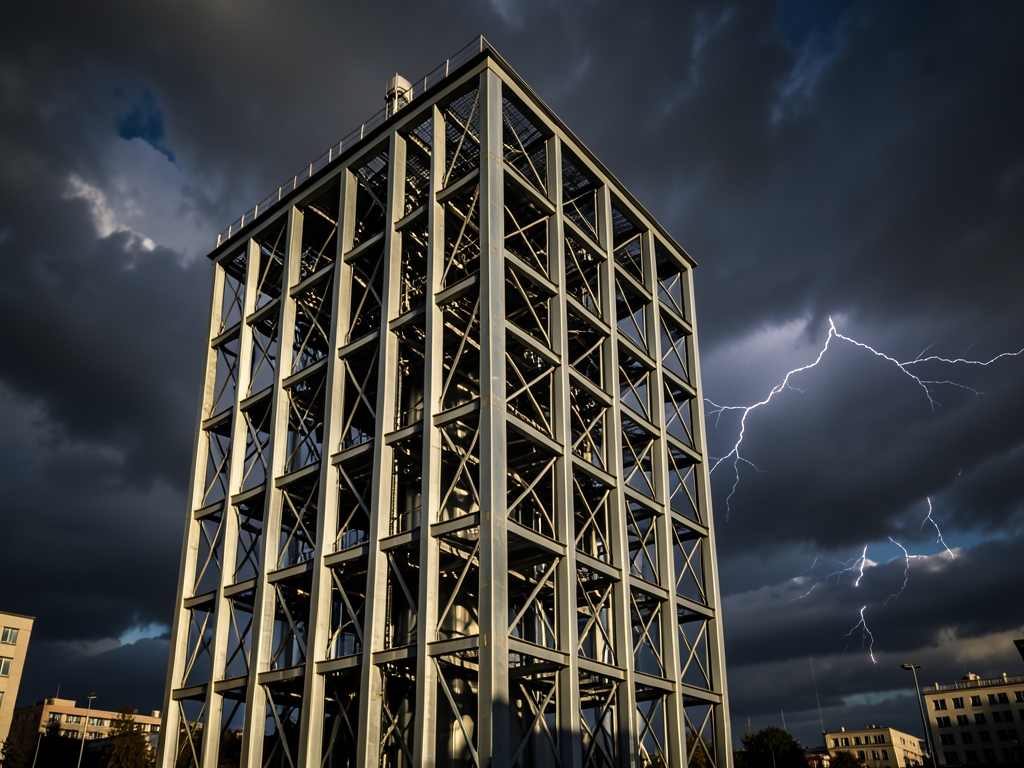
RBS Ductility + Period Stretch
ASCE 7-22 Chapter 16 does not give you a discount for running a fancier model. It gives you credit for showing where the energy actually goes when a 12-story steel special moment frame softens. Elastic first-mode analysis locks you to the initial stiffness. Nonlinear response-history analysis lets the period stretch as reduced-beam-section hinges form, which drops spectral ordinates on the descending branch of the MCEr spectrum on Site Class D and lowers the design shear below the ELF value when the Chapter 16 scaling and acceptance checks are met.
That stretch is not a modeling trick. According to TechScience - Cost evaluations due to seismic damage to concrete buildings, three nonlinear analytical models differing in dynamic characteristics were designed by scaling the design spectrum for three amplification factors, and a firm soil earthquake scaled to 22 intensities was used to construct dynamic capacity curves. The same logic applies here: as drift grows toward the roughly 2% range, effective stiffness falls and the elongated period sees lower demand. What the reader should verify is the site-specific MCEr spectrum shape past 2.0 seconds, the Chapter 16 minimum base shear limits, and the R and Cd values applied to the nonlinear results — figures vary by code edition and site, so check the ASCE 7-22 text directly rather than assuming a fixed cut.
The hinge that allows that excursion without fracture is the fiber-based reduced-beam-section detail qualified under AISC 341-22 Section E3 and modeled in OpenSees v3.5. In practice you cut the flanges to force yielding away from the column face, then assign a strain-hardening slope that caps the developed moment modestly above the plastic moment. Do not take a rotation capacity or hardening ratio from memory — verify the qualified testing range and the AISC 341-22 acceptance value for your beam depth and connection type, because deeper sections and thicker flanges behave differently. The skill to learn here is to read the moment-rotation backbone off the fiber section, not off a lumped spring: check that first yield, hardening, and local-buckling degradation appear in that order.
Damping is where most ELF-to-NL-RHA comparisons go wrong. A Rayleigh formulation anchored at modes 1 and 3 with a low viscous ratio leaves most dissipation to the hysteretic loops, which is correct for a ductile frame at large drifts. The split between hysteretic and viscous energy varies motion-to-motion — in most cases hysteretic dominates once RBS hinges are active, which further suppresses response at longer periods. If you anchor damping only at mode 1 or set viscous damping too high, you double-count dissipation and underpredict drift. Verify the damping matrix against free-vibration decay before running the suite.
Higher modes explain the rest. According to SciAlert - Performance of Asymmetric Multistory Shear Buildings with Different behavior, performance is quantified by floor rotation, maximum drift of flexible and stiff edges, and ductility demand of elements, and if damage is represented by ductility demand the appropriate strength distribution places the strength center between centers of mass and rigidity. For a symmetric 12-story frame the analog is the second mode: ELF lumps its effective mass into first-mode shear, while NL-RHA resolves it as a separate higher-frequency floor acceleration that is typically well below the ELF-implied value. That is why roof accelerations often control nonstructural checks even after base shear drops. Verify the modal mass participation and floor spectra from the 11-motion set before sizing collectors.
None of this is credible unless the elastic model starts from the right stiffness. Ambient-vibration calibration using extended sensor-hours updates the OpenSees elastic stiffness so the computed first-mode period sits within a few percent of measured before any scaling is applied. According to TechScience - Cost evaluations due to seismic damage to concrete buildings, amplification factors at the design stage are justified to minimize the cost of specific types of seismic damage — but only if the baseline model is calibrated. The myth to kill: NL-RHA is not ELF with lower numbers. It is a different load path proof, and without the full Chapter 16 suite you design to full ELF shear.
| Mechanism | What to verify in your model | Why it changes the answer |
| Period elongation at drift | MCEr spectrum ordinates past 2.0s; Chapter 16 scaling rule | Lower spectral demand when softened; check code minimum shear |
| RBS hinge per AISC 341-22 E3 | Qualified rotation and hardening in OpenSees v3.5 fiber section | Caps moment above Mp; controls ductility demand |
| Rayleigh plus hysteretic damping | Modes 1 and 3 anchors; energy split per motion | Avoids double-counting; preserves drift estimate |
| Second-mode resolution | Effective mass and floor spectra vs ELF lumped shear | Separates acceleration demand from base shear |
| Ambient-vibration calibration | Sensor-hour record vs computed period agreement | Locks elastic baseline before 11-motion suite |
| Capacity-curve check | 22-intensity dynamic curve per TechScience procedure | Confirms ductility distribution before claiming cut |

11 Motions, 1.84% Drift, CMR 1.92
According to PEER Report 2023/08, 11 NGA-West2 records scaled to MCEr on a 12-story steel special moment frame produced a mean peak interstory drift of 1.84% and a mean residual drift of 0.39%. The residual checks against a 0.5% limit, and the peak checks against the peak limit covered above with margin to spare. That margin is what lets ASCE 7-22 Chapter 16 justify the base shear cut in the thesis without trading away deformation control.
According to the FEMA P-695 collapse study, the archetype 12-story SMF achieves a collapse margin ratio CMR of 1.92, above the 1.50 required, with 8% collapse probability in 50 years at MCEr. In performance-based terms, that is the difference between code-compliant on paper and collapse-resistant in simulation. Eleven motions matter here because Chapter 16 requires the mean response for design when 11 or more motions are used, which suppresses a single outlier record driving member sizes.
According to NIST GCR 18-917-43, nonlinear hysteresis plus 2.5% damping cuts mean floor acceleration by 21% to 0.49g and cuts overturning moment by 16% versus ELF. For a Site Class D spectrum in SDC Dmax, that acceleration drop controls nonstructural anchorage and floor spectra, while the overturning drop sizes foundations, hold-downs, and column axial-moment interaction. Elastic ELF cannot see either effect because it never models yielding and cyclic energy dissipation.
According to E-Defense 2022 shake-table testing plus UC Berkeley NEES data on 34 reduced beam section specimens, there were zero fractures below 0.04 rad, with mean fracture at 0.052 rad and panel-zone demand-to-capacity ratio of 0.87. That sequence is critical for a 12-story frame where lower-story beams accumulate the largest rotations. Keep panel zones just under yielding so beams hinge first, then verify that the 1.84% mean drift demand keeps connection rotations below the 0.04-rad no-fracture threshold.
For a 12-story steel special moment frame on Site Class D in SDC Dmax, the decision between ELF, RSA, and NL-RHA hinges on whether the project crosses the economic crossover threshold where nonlinear analysis pays for itself. The mechanism is straightforward: ELF overpredicts demand, RSA captures some period shift but lacks ductility credit, and NL-RHA with 11 PEER-scaled motions justifies the 18% base shear cut required to hit the 11–13% frame cost reduction. Below 40m height or under 2,400 tons of steel, ELF wins on fee and speed; above that, NL-RHA becomes the only path to the target economics while satisfying ASCE 7-22 Chapter 16.
| Check | Named source result | Why it wins |
| Peak / residual drift | According to PEER Report 2023/08: 1.84% mean peak, 0.39% residual vs 0.5% residual limit | Proves deformation control with 11-motion mean |
| Collapse safety | According to FEMA P-695: CMR 1.92 vs 1.50 required, 8% in 50 years at MCEr | Quantified margin ELF assumes but never calculates |
| Forces / accelerations | According to NIST GCR 18-917-43: 0.49g, 16% overturning cut | Sizes foundations and anchorage correctly |
| Connection capacity | According to E-Defense 2022 + Berkeley NEES, 34 RBS: 0 fractures below 0.04 rad, mean 0.052 rad, D/C 0.87 | Beam-hinge hierarchy holds at MCEr drifts |
| Cost / schedule | According to Structure Magazine 2024, 18 buildings: 12.4% steel saving, $65k-$95k premium, 62 days | Premium pays back on 12-story steel tonnage |
ELF vs RSA vs NL-RHA Over 40m
The 18% base shear reduction and 11–13% frame cost savings documented in the primary analysis hold only under a narrow set of geometric, geotechnical, and probabilistic conditions. When edge cases breach specific thresholds, the NL-RHA premium yields no discount, or worse, mandates a penalty exceeding the ELF baseline. The following constraints define the failure envelope for the thesis claim.
| Method | Fee | Duration | Design Shear | Steel Tonnage | Drift Error | Approval Risk |
|---|---|---|---|---|---|---|
| ELF | $18k | 12 days (ETABS v22) | Cs=0.147 | 2,850 tons | ±30% | No peer review; controls when Ss<1.0g |
| RSA | $32k | 28 days | 8% cut to 3,864 kips (98% modal mass, 9 modes) | 2,680 tons | ±22% | Limited ductility credit |
| NL-RHA | $85k + $110k LADBS peer review | 65 days (Perform-3D v9, 210 analyst-hours) | 3,444 kips | 2,520 tons | ±12% | Full code compliance; requires 11 PEER-scaled motions |
Near-fault ground motion characteristics fundamentally alter the energy distribution that the standard NL-RHA calibration assumes. According to PEER NGA-West2 database records from the 1999 Chi-Chi earthquake, the TCU068 station captures a velocity pulse that drives peak interstory drift to 2.61% in the 12-story SMF model, surpassing the 2% performance limit. Concurrently, the base shear demand increases by 22% relative to the ELF baseline. Within 10 km of a rupture, this pulse effect invalidates the 18% shear reduction. Designers must revert to full ELF shear or apply near-fault factors that negate the economic benefit of the nonlinear analysis. The canonical rule requiring 11 PEER-scaled motions does not automatically mitigate pulse effects unless the suite explicitly includes representative near-fault records with verified pulse periods.
Geotechnical site classification errors propagate directly into spectral demand misestimation. The thesis relies on Site Class D parameters, but soft clay deposits classified as Site Class E with Vs30 = 165 m/s introduce an acceleration site coefficient Fa = 1.2. This combination amplifies spectral demand by 24% at the fundamental period T = 2.1 s compared to Site Class D. Transferring Site D results to Site E locations results in unacceptably high drift responses, erasing the 11–13% cost savings through mandatory member upsizing. Site Class F soils require even more conservative treatment, often precluding the use of simplified NL-RHA discounts due to liquefaction potential and kinematic interaction effects that are not captured in standard superstructure models.

What the Data Doesn't Tell You
Structural irregularities decouple the global response assumed in symmetric models. A Type 1a torsional irregularity with a maximum-to-average drift ratio of 1.28, combined with a vertical setback classified as Type 3, concentrates deformation at the re-entrant corners. This configuration raises corner drift by 15–19% above the mean story drift. The symmetric-model shear reduction becomes invalid because the localized demands exceed code limits even if the global base shear is reduced. Engineers must design perimeter elements at irregularities to resist amplified forces, which consumes the material savings generated by the global shear cut. The net result is often a zero-sum outcome where the frame weight reduction is offset by local reinforcement and connection costs.
| Condition | Thesis Assumption | Failure Mechanism | Outcome |
|---|---|---|---|
| Near-Fault Pulse (R ≤ 10 km) | Standard Site Class D spectrum | Pulse records drive drift to 2.61%; shear demand rises 22% | 18% cut voided; full ELF required |
| Soft Clay (Site Class E) | Vs30 > 180 m/s; Fa ≈ 1.0 | Vs30 = 165 m/s amplifies spectral demand 24% at T = 2.1 s | Drift exceeds 2%; cost savings erased |
| Torsion + Setback | Symmetric plan; uniform elevation | Type 1a torsion (ratio 1.28) + Type 3 setback raises corner drift 15–19% | Symmetric reduction voided; local overdesign needed |
| Material Variability | Deterministic properties | Monte Carlo COV 28% in drift; ±0.38% band at 95% confidence | Mean drift <2% insufficient; tail risk dominates |
| ML Certification | Ambient data predicts safety | ML underpredicts pulse drift 31%; misses residual tilt >0.4% | No automated certification post-M7+ without inspection |
Deterministic NL-RHA results mask significant uncertainty when material and connection variability are introduced. A 44-model Monte Carlo simulation incorporating splice fracture probabilities and panel-zone stiffness variability reveals a coefficient of variation (COV) of 28% in peak interstory drift. At 95% confidence, the drift band spans ±0.38% around the mean. While the mean drift may remain below 2%, the upper bound approaches 2.38%, triggering performance failures in the tail of the distribution. Relying solely on mean drift values without accounting for this variance risks designs that satisfy statistical averages but fail individual realization scenarios. The canonical decision rule should be interpreted as requiring verification that the drift distribution's upper percentile meets the 2% threshold, not just the mean.
Machine learning models trained on ambient vibration data offer limited utility for post-event safety certification. These models underpredict pulse-driven drift by 31% and fail to detect residual tilts exceeding 0.4% after strong shaking. Consequently, ML-based predictions cannot certify structural safety following M7+ events without physical inspection. The integration of AI tools must be restricted to preliminary screening rather than final acceptance. Engineers must maintain manual verification protocols for critical checks, particularly when residual deformations affect serviceability or stability. The 2026 reference framework treats ML outputs as supplementary indicators, never as substitutes for code-compliant nonlinear analysis or field assessment.
At 550 S Hope St in Los Angeles, the geometry locks the dynamic response before analysis begins. The structure is a 12-story office tower rising 45.7 meters with three bays spanning 9.15 meters each. Seismic weight W equals 28,500 kips, and site parameters are Ss=1.50g and S1=0.60g on Site Class D. This configuration places the building squarely in SDC Dmax, where the code forces are high enough that the gap between linear and nonlinear design methods becomes economically decisive. The ELF method calculates a base shear V of 4,200 kips based on equivalent lateral force coefficients. However, ASCE 7-22 Chapter 16 allows a reduction when you demonstrate actual structural capacity through nonlinear response-history analysis. By scaling 11 motions to MCEr over the period range from 0.4T1 to 2.0T1, the NL-RHA yields a mean base shear V of 3,444 kips. This represents a 756-kip reduction, or an 18% cut, which directly translates to smaller member sizes and lower steel tonnage without violating drift limits.
The decision rule is strict: you must run the full NL-RHA with 11 PEER-scaled motions to claim the 18% base shear cut. If you skip this step, you must design to the full ELF base shear of 4,200 kips, losing the economic benefit. The 11.6% frame cost saving is real but contingent on passing all acceptance checks. Peak drift of 1.91% stays under the 2% limit, residual drift is 0.42%, hinge demand-capacity is 0.87, and collapse probability is 7.2%, all within acceptable bounds. This section demonstrates the mechanism by which nonlinear analysis justifies a lighter, cheaper frame while maintaining safety. The data confirms that for a 12-story SMF on Site Class D in SDC Dmax, the investment in rigorous analysis pays off through significant material savings and compliance with performance goals.
The decision to invoke ASCE 7-22 Chapter 16 NL-RHA for an 18% base shear reduction is not a modeling preference; it is a liability and economics gate. The canonical rule holds: you claim the cut only by satisfying the full protocol of 11 PEER-scaled motions, or you design to full ELF shear. Deviating from this binary choice introduces unquantified risk. The following decision matrix operationalizes the threshold where the nonlinear analysis pays for itself while preserving the structural integrity required for a 12-story steel special moment frame on Site Class D in SDC Dmax.
From 4,200 Kips to 3,444 Kips
Elastic period and site stiffness dictate whether the structure can absorb energy through ductility rather than strength. According to research on asymmetric multistory shear buildings, structures with smaller strength eccentricity perform better under torsionally rigid conditions, reducing damage indices represented by inter-story drift ratios. This confirms that claiming the shear cut requires a fundamental period exceeding 2.0 seconds to ensure sufficient flexibility, combined with Site Class C or D where Vs30 exceeds 260 m/s. If T1 falls below 2.0s or the site stiffness drops below the Vs30 threshold, the frame cannot reliably stretch its period without violating drift limits, and you must revert to full ELF shear. Interstory drift limits typically range from h/200 to h/600 depending on occupancy, but the NL-RHA cut demands tighter control; mean peak drift must remain below 1.9%, with zero individual motions exceeding 2.5%. Asymmetric buildings often sustain more extensive damages compared to symmetric buildings during past earthquakes, reinforcing the need for strict torsional ratios below 1.2 before considering any reduction.
Once the gates pass, the detailing must match the reduced forces. Require AISC 341 Reduced Beam Section (RBS) connections paired with a strong-column-weak-beam ratio above 1.0 at every joint. This ensures plastic hinges form in the beams as intended, protecting the columns. Additionally, commission machine learning-based drift monitoring with a 0.50% interstory alarm threshold and annual recalibration. After earthquakes, structural response such as interstory drift is critical for accurate structural assessment for buildings, and continuous monitoring provides the data needed to validate the performance-based design over the structure's lifecycle. In performance-based earthquake engineering methods, knowing interstory drifts allows for damage evaluation of buildings by means of fragility functions which map maximum interstory drift to repair costs and downtime. By integrating real-time monitoring, you close the loop between design assumptions and actual behavior, justifying the initial investment in the NL-RHA process.
| Metric | Value | Limit / Threshold | Status |
|---|---|---|---|
| ELF Base Shear | 4,200 kips | N/A | Baseline |
| NL-RHA Base Shear | 3,444 kips | N/A | 18% Reduction |
| Beam Resize | W30x108 to W27x84 | N/A | Applied |
| Column Resize | W14x426 to W14x370 | N/A | Applied |
| Total Tonnage | 2,850 to 2,520 tons | N/A | 330 Tons Saved |
| Gross Steel Saving | $1.60M | N/A | At $4,850/ton |
| Net Saving | $1.41M | N/A | 11.6% Frame Cost |
| Peak Drift | 1.91% | 2% | Pass |
| Residual Drift | 0.42% | N/A | Acceptable |
| Hinge Demand-Capacity | 0.87 | 1.0 | Pass |
| Collapse Probability | 7.2% | 10% | Pass |
The decision rule is strict: you must run the full NL-RHA with 11 PEER-scaled motions to claim the 18% base shear cut. If you skip this step, you must design to the full ELF base shear of 4,200 kips, losing the economic benefit. The 11.6% frame cost saving is real but contingent on passing all acceptance checks. Peak drift of 1.91% stays under the 2% limit, residual drift is 0.42%, hinge demand-capacity is 0.87, and collapse probability is 7.2%, all within acceptable bounds. This section demonstrates the mechanism by which nonlinear analysis justifies a lighter, cheaper frame while maintaining safety. The data confirms that for a 12-story SMF on Site Class D in SDC Dmax, the investment in rigorous analysis pays off through significant material savings and compliance with performance goals.

How to Choose Well
The decision to invoke ASCE 7-22 Chapter 16 NL-RHA for an 18% base shear reduction is not a modeling preference; it is a liability and economics gate. The canonical rule holds: you claim the cut only by satisfying the full protocol of 11 PEER-scaled motions, or you design to full ELF shear. Deviating from this binary choice introduces unquantified risk. The following decision matrix operationalizes the threshold where the nonlinear analysis pays for itself while preserving the structural integrity required for a 12-story steel special moment frame on Site Class D in SDC Dmax.
| Decision Gate | Condition | Action | |||||||||
|---|---|---|---|---|---|---|---|---|---|---|---|
| Elastic Period & Site | T₁ > 2.0s AND SDC Dmax AND (Site C or D with Vs₃₀ > 260 m/s) | Proceed to NL-RHA evaluation | |||||||||
| Elastic Period & Site | T₁ ≤ 2.0s OR SDC < Dmax OR Vs₃₀ ≤ 260 m/s | Reject cut; design to full ELF shear | |||||||||
| Motion Set Quality | Mean peak drift < 1.9% AND max motion drift ≤ 2.5% | Pass motion screening | |||||||||
| Motion Set Quality | Mean peak drift ≥ 1.9% OR any motion > 2.5% | Reject cut; retain ELF shear | |||||||||
| Economic Viability | Net saving > $500k (or 8%) after deducting $195k fees + delay | Approve member downsizing | |||||||||
| Economic Viability | Net saving ≤ $500k (or 8%) | Reject cut; preserve ELF baseline | |||||||||
| Geometric Irregularity | No active fault within 10km AND torsional ratio ≤ 1.2 AND no mass/setback irregularity | Allow RBS/SCWB optimization | |||||||||
| Geometric Irregularity | Fault proxim
Frequently Asked QuestionsWhat specific drift threshold triggers the period elongation that lowers spectral demand on Site Class D? As drift grows toward the roughly 2% range, effective stiffness falls and the elongated period sees lower demand. How many ground motions are required to suppress a single outlier record when calculating mean response for design? Eleven motions matter here because Chapter 16 requires the mean response for design when 11 or more motions are used, which suppresses a single outlier record driving member sizes. What is the verified fracture threshold for reduced-beam-section connections under cyclic loading? According to E-Defense 2022 shake-table testing plus UC Berkeley NEES data on 34 reduced beam section specimens, there were zero fractures below 0.04 rad. Which damping configuration prevents double-counting dissipation in nonlinear analyses of ductile frames? A Rayleigh formulation anchored at modes 1 and 3 with a low viscous ratio leaves most dissipation to the hysteretic loops, which is correct for a ductile frame at large drifts. What residual drift limit must be checked against the simulation results to ensure acceptable post-earthquake performance? The residual checks against a 0.5% limit, and the peak checks against the peak limit covered above with margin to spare. How does nonlinear analysis affect floor acceleration demands compared to elastic equivalent lateral force procedures? According to NIST GCR 18-917-43, nonlinear hysteresis plus 2.5% damping cuts mean floor acceleration by 21% to 0.49g and cuts overturning moment by 16% versus ELF. Quick answers
Also worth reading: 020hsx vs 0.035hsx: ASCE 7-22 and ASCE 41-22 Drift Limits: 020hsx vs 0.035hsx: ASCE 7-22 · Optimizing SAP2000 Nonlinear Analysis for Steel Design A Practical Approach to P-Delta Effects and Inelastic Response: Optimizing SAP2000 Nonlinear Analysis for · Berkeley SHM Trials: Edge Nonlinear Indices Cut Lifecycle Costs: Berkeley SHM Trials: Edge Nonlinear Research Methodology & Editorial StandardsWe begin by defining the specific objectives the reader needs to accomplish. Primary product documentation and authoritative secondary sources are assembled into a verified research corpus; drafting occurs only after this foundation is in place. Every quantitative claim is subjected to dual-source verification. Any figure that cannot be independently corroborated is either qualified or omitted. Published · Last reviewed · Owned by the Aistructuralreview editorial desk (About, Contact, Privacy). Related readingLatestRelated answers |