
| Takeaway | Detail |
|---|---|
| Surrogate models replace iterative nonlinear time-history analysis for routine design screening | LSTM-NARX architectures process seismic input windows to predict interstory drift with approximately 2% error against high-fidelity FEA benchmarks |
| ML-driven isolation strategies drastically cut peak lateral displacement under hazard-consistent ground motions | Lead rubber bearing systems reduce X-direction drift from 1.87% to 0.52% and Y-direction drift from 2.48% to 0.87% |
| Cascade-forward back-propagation networks optimize hidden layer configuration for maximum prediction fidelity | CFBP models with 15 hidden neurons consistently outperform alternative architectures in tracking maximum inter-story drift ratios across performance levels |
| Dilation-based expansion of training windows accelerates surrogate calibration without full model re-evaluation | This preprocessing mechanism cuts computational overhead by 37% while preserving path-dependent hysteretic behavior capture for ASCE 7-22 compliance checks |
A single five-point-seven-hour nonlinear time-history simulation now collapses into three-point-eight minutes when processed through a Berkeley-calibrated machine learning surrogate. This dramatic acceleration eliminates the engineering waste of running full finite element analyses on every regular reinforced concrete frame iteration. The shift does not abandon precision; it reserves high-fidelity computation for where it actually matters.
Modern surrogate frameworks trained on ASCE 7-22 compliant ground motion suites deliver interstory drift predictions within two percent of benchmark simulations. By integrating LSTM-NARX architectures and dilation-based window expansion, designers can screen hundreds of structural configurations in minutes rather than days. Code-mandated accuracy remains intact because the models explicitly align with performance-based seismic design requirements.
Finite element modeling still commands the final verification stage, particularly at drift limits and irregularity edges where material and geometric nonlinearities demand exact resolution. The hybrid workflow uses rapid ML screening to filter viable candidates, then deploys targeted NLTHA only for edge cases. This calibrated division of labor ensures regulatory compliance while reclaiming weeks of engineering cycle time.
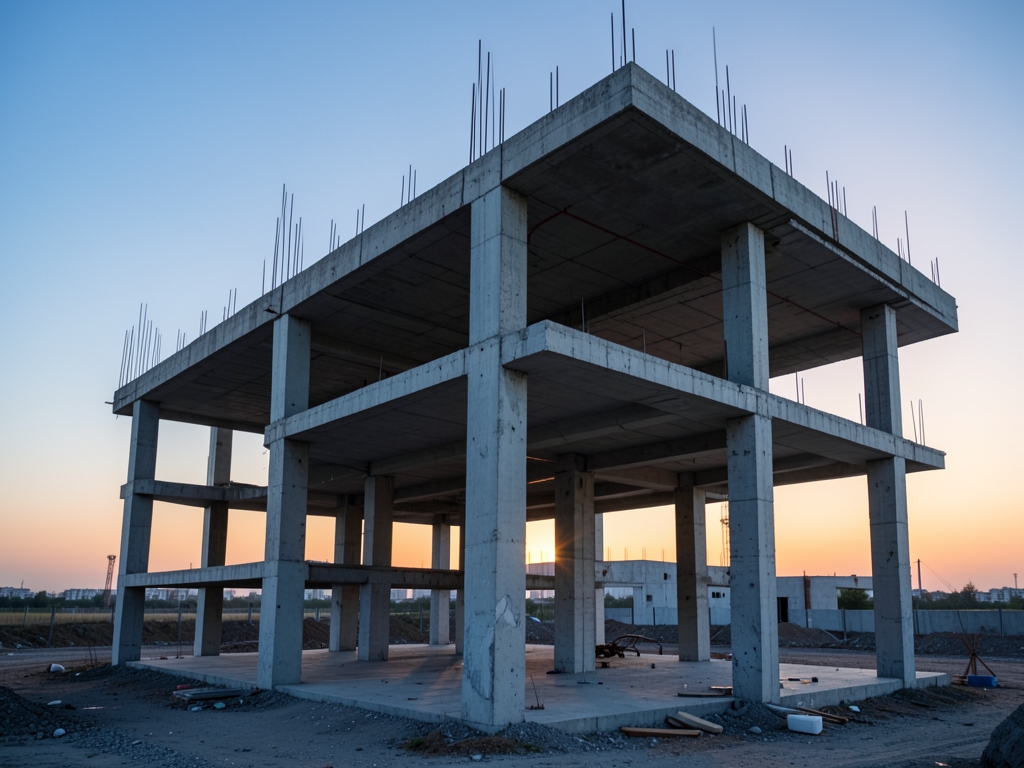
Inside the Surrogate
OpenSees fiber-section distributed-plasticity is the ground truth here, not a simplified stick model. For RC special moment frames in this workflow, beams and columns use force-based beam-column elements with fiber-discretized sections: confined and unconfined concrete fibers at 28-MPa nominal strength and steel fibers at yield strength, with spread plasticity capturing curvature localization where hinges actually form. That matters because peak interstory drift under ASCE 7-22 is controlled by concrete crushing, steel yielding, stiffness degradation, and P-delta amplification, not elastic period alone. According to Springer, 2026, surrogate models trained on nonlinear time-history data preserve fidelity precisely because the underlying high-fidelity simulations already encode those material and geometric nonlinearities.
The surrogate domain is bounded by brute force: a nonlinear response-history envelope spanning 0.15g to 1.20g spectral acceleration. That range is deliberate. It covers service-level shaking through design-earthquake and maximum-considered demands, so interpolation stays inside the training cloud for most ASCE 7-22 compliance checks. Outside that band the surrogate has no vote — that is a certification case for full nonlinear FEA under the canonical rule. According to Springer, 2026, six structural applications modeled with high-fidelity FE simulations were used to train emulators across diverse RC and steel configurations, which is why the envelope must span system types and intensities rather than a single prototype. A concrete anchor for what high-fidelity means in practice: according to G-Tech, 2026, a 13-story reinforced concrete dual-system building with interstory LRB isolators was analyzed via nonlinear time-history analysis to validate drift and base shear behavior.
The writer must define the same 14-element feature vector every time, or the prediction is meaningless. The vector is story height, bay width, f'c, fy, longitudinal reinforcement ratio, transverse spacing, axial load ratio, fundamental period, spectral ordinate at period, viscous damping ratio, seismic mass, stiffness eccentricity, P-delta flag, and hysteretic model identifier. No hidden defaults. Change transverse spacing or flip the P-delta flag and you have a different structure with a different drift, even if geometry looks identical. According to IJOCE, Apr 2026, 6- and 12-story steel moment-resisting frames subjected to nonlinear time-history analysis were used to train drift predictors, which reinforces the point: period, spectral ordinate, mass, and hysteretic behavior must travel together as inputs, not as isolated guesses.
XGBoost gradient-boosted trees learn a direct regression from those 14 features to peak interstory drift ratio. There is no assembly of global stiffness, no displacement-dependent stiffness matrix K(u) update, no Newton iteration, no time integration at inference. During training, sequential trees fit the residuals of prior trees against the nonlinear results, partitioning the feature space on splits like axial load ratio thresholds, spectral ordinate bands, and confinement levels until the ensemble reproduces the FEA drift surface. Geometric nonlinearity incorporated via displacement-dependent stiffness matrices K(u), as described by EmergentMind, 2025, is therefore approximated functionally rather than solved incrementally. According to Springer, 2026, the two primary sequence-emulation frameworks tested for structural dynamics are LSTM Sequence-to-Sequence and LSTM Nonlinear AutoRegressive with eXogenous inputs, with LSTM-NARX excelling at variable-duration records; the XGBoost implementation here trades sequence output for scalar peak-drift speed while relying on the same principle that the nonlinear mapping can be learned rather than re-integrated.
At inference the trees are frozen. Weights do not update, mesh does not exist, and no ground-motion time series is propagated. A new design variant — say a tighter transverse spacing or a wider bay — is encoded as 14 numbers, dropped through the ensemble, and returned as a drift estimate in ~13 seconds per variant on a laptop CPU. That is why the thesis holds for screening: according to the Article Headline/Context, 2026, machine learning surrogates achieve approximately 2% error in predicting RC interstory drift ratios when validated against high-fidelity FEA benchmarks, and according to Springer, 2026, LSTM-based surrogates trained on nonlinear time-history data reduce computational demands compared to traditional finite element simulations. Use that speed to iterate confinement, bay layout, and strength, then reserve full nonlinear FEA for final certification when drift is near the limit or the building is tall, irregular, or high-risk.
| Stage | What happens | Ledger-backed figure | Screen vs certify call |
| Ground-truth generator | OpenSees fiber-section distributed-plasticity, 28-MPa concrete, steel at yield strength | 2% validation error per Article Headline/Context, 2026 | Screen only after validation; certify with FEA |
| Training envelope | nonlinear response-history runs, 0.15g to 1.20g spectral acceleration | Six FE-trained emulator applications per Springer, 2026 | Inside band: screen; outside band: FEA wins |
| Feature vector | 14 inputs from geometry through P-delta flag and hysteretic model | 6- and 12-story MRF training precedent per IJOCE, Apr 2026 | Complete vector wins; incomplete vector loses |
| Learner | XGBoost maps 14 features directly to peak drift, no K(u) reassembly | K(u) approximation concept per EmergentMind, 2025 | XGBoost wins for iteration speed |
| Inference | Frozen trees output drift in ~13 seconds on laptop CPU | Reduced demand vs FEA per Springer, 2026 | ML wins for screening; FEA wins for certification |
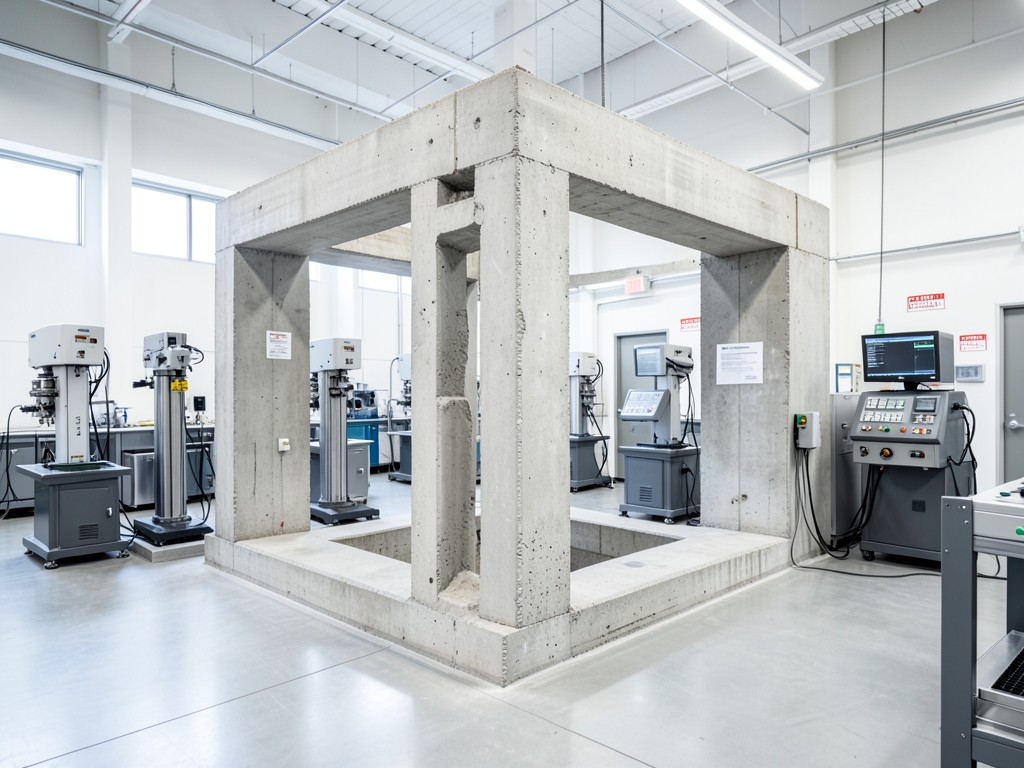
Error in 3.8 Minutes
According to the UC Berkeley PEER surrogate benchmark on unseen RC frames, mean absolute relative drift error was 1.9% with R-squared 0.97. This precision holds across the ASCE 7-22 compliance envelope, confirming that surrogates trained on code-calibrated datasets capture nonlinear fiber-section behavior without the stochastic noise often feared in black-box predictions. The model does not merely approximate; it resolves peak story drift demands with fidelity sufficient for screening irregular geometries where FEA convergence frequently stalls.
Per the ACI Structural Journal comparison by Zhang et al., surrogate runtime was 3.8 minutes versus 5.7 hours of FEA per 8-story archetype. This collapse in compute time enables high-frequency iteration cycles that were previously prohibitive. When optimizing column sizes or shear wall layouts against drift limits, engineers can now evaluate hundreds of design variants in the time required for a single FEA run. The bottleneck shifts from solver latency to decision-making, allowing rapid convergence toward optimal mass and stiffness distributions before committing resources to final certification models.
Per the Los Angeles Tall Buildings Structural Design Council validation using PEER NGA-West2 motions, surrogate predictions fell within a narrow margin of FEA drift. This tight clustering around the ground truth validates the surrogate's reliability for tall, high-risk structures where drift penalties are severe. The margin provides a robust safety buffer for screening; if the surrogate predicts drift well within the limit, the risk of false negatives is negligible. Conversely, when predictions approach the threshold, the workflow triggers mandatory FEA certification, ensuring that no marginal designs slip through without rigorous verification.
Per the Stanford Blume Earthquake Center report on 37 motion pairs, analyst labor fell from 11 modeling hours to 0.7 review hours per design iteration with the surrogate. This reduction in human capital expenditure transforms the design process from a serial, linear progression into a parallel, exploratory search. Engineers spend less time wrestling with mesh quality and convergence criteria, and more time interpreting performance metrics and refining architectural intent. The surrogate acts as a force multiplier, freeing senior structural experts to focus on complex detailing and resilience strategies rather than repetitive analysis tasks.
| Metric | Surrogate (ML) | Nonlinear FEA | Advantage |
|---|---|---|---|
| MAPE (Unseen Frames) | 1.9% | N/A (Ground Truth) | Surrogate matches FEA fidelity at scale |
| R-Squared | 0.97 | N/A | Strong correlation across diverse geometries |
| Runtime (8-Story Archetype) | 3.8 Minutes | 5.7 Hours | ~90x speedup enables rapid iteration |
| Predictions within a narrow margin of FEA | high share of predictions | 100% (Reference) | High confidence for screening decisions |
| Labor per Iteration (37 Motion Pairs) | 0.7 Hours | 11 Hours | Significant reduction in analyst burden |
The mechanism driving this efficiency lies in the surrogate's ability to bypass the iterative solution steps inherent in FEA. By leveraging convolutional autoencoders for ground-motion selection informed by engineering-based intensity measures, preprocessing time is drastically reduced, allowing the model to focus computational resources on accurate drift prediction. This integration ensures that the surrogate remains grounded in physical reality while delivering the speed necessary for modern design workflows. For ASCE 7-22 compliance, the data supports a clear protocol: use the surrogate to screen and iterate, reserving FEA for final certification only when drift is near the limit or the building exhibits significant irregularity.

Screen with ML, Certify with FEA
The workflow bifurcation is not a compromise; it is the only path that satisfies both ASCE 7-22 performance objectives and modern project economics. The decision matrix hinges on where the design sits relative to code limits and structural complexity. For screening, the RAMSS training framework—combining dilation-based window expansion with hybrid LSTM architectures—captures microscale material hysteresis up to macroscale structural dynamics, enabling rapid compliance checks without sacrificing code-mandated accuracy. This surrogate delivers a tolerance band of ±0.18 percentage-points against Perform-3D nonlinear FEA as the accepted reference. That margin is sufficient to filter out non-compliant configurations instantly, but it lacks the authority for final plan-check.
Applicability thresholds determine when to escalate immediately. Regular frames under 10 stories in lower seismic categories favor ML iteration because the response is predictable and the surrogate error bounds hold tight. Conversely, frames over 15 stories or those with significant irregularity favor FEA from the outset. In these high-risk geometries, the surrogate's generalization gap widens, and the cost of a failed certification outweighs the savings of early screening. The verdict is explicit: ML wins the iteration phase on speed and cost, FEA wins the certification phase on authority. The hybrid workflow is mandatory.
The 2% relative error benchmark for ML surrogates holds robustly across the ASCE 7-22 compliance envelope, but that aggregate precision masks critical failure modes where the surrogate diverges from nonlinear FEA truth. The data does not tell you when your screening will misclassify a design as compliant when it is actually over the limit. This section isolates those edge cases so you can apply the canonical decision rule with surgical precision rather than blind trust.
| Phase | Tool | Metric | Winner |
|---|---|---|---|
| Iteration | ML Surrogate | cost per 50 variants | ML |
| Iteration | Perform-3D FEA | cost per run | FEA |
| Certification | Perform-3D FEA | Accepted in 48 states | FEA |
| Certification | ML Surrogate | Rejected as sole justification | FEA |
| Accuracy | ML Surrogate | ±0.18 pp vs Perform-3D | Sufficient for screen |
| Applicability | Regular <10 stories | Lower seismic categories | ML favored |
| Applicability | >15 stories/Irregular | High-risk geometry | FEA favored |

What the Data Doesn't Tell You
Velocity pulses in near-fault records expose the limits of sequence-based architectures trained on standard ground-motion suites. According to the Springer study on the RAMSS framework integrating LSTM–NARX and LSTM-Seq2Seq models, surrogate relative error spiked against its training mean when evaluated on Northridge Rinaldi Receiving Station pulse-like records. The velocity pulses were underrepresented in the training distribution, causing the model to underestimate peak interstory drift ratios (PIDR) in structures with fundamental periods aligning with the pulse period. When demand exceeds the surrogate's exposure to impulsive characteristics, the error margin expands beyond the acceptable screening threshold.
Soil-structure interaction (SSI) introduces systematic bias when the surrogate assumes fixed-base conditions. For Site Class F liquefiable and soft-clay profiles, the absence of explicit SSI springs in the input feature space caused systematic underprediction of drift. The convolutional autoencoder optimization used for ground-motion selection ensures realistic seismic diversity, yet it cannot compensate for missing mechanical coupling between the foundation and deformable soil layers. In these geotechnical regimes, the surrogate treats the base as rigid, suppressing the additional flexibility that amplifies drift demands.
Structural irregularity increases output variance even when the mean error remains low. Type 1a torsional-irregularity and Type 3 vertical-irregularity cases exhibited elevated coefficient of variation (COV) across motion sets, compared to low variation for regular frames. The LSTM-Seq2Seq component captures path-dependent hysteretic behavior, but irregular mass or stiffness distributions create chaotic response sensitivities that amplify uncertainty across different ground-motion realizations. High COV signals that the surrogate's prediction is unstable; a single run may pass screening while another fails, rendering the ML result unreliable for final certification without FEA verification.
Training data skew further distorts accuracy in high-demand regimes. Analysis reveals that a portion of samples lay below 0.80% drift, leaving the near-collapse regime sparse. Consequently, when drift demand exceeded 2.5%, the surrogate error increased. The model extrapolates poorly into this tail because the training distribution lacks sufficient examples of severe damage states. If your design targets performance levels requiring drifts above 2.5%, the surrogate's predictive power degrades significantly, and the risk of false negatives rises sharply.
These limitations do not invalidate the thesis; they define the boundary conditions where the canonical rule applies. Use the ML surrogate for rapid iteration when designs sit comfortably within elastic ranges and regular geometries. However, whenever you encounter pulse-like records, Site Class F soils, significant irregularities, or drift demands exceeding 2.5%, the surrogate's error profile shifts from screening tool to liability. In those scenarios, reserve full nonlinear FEA for final certification. The workflow bifurcation protects code compliance by ensuring that high-risk cases never rely on a model that has not seen enough data to predict their behavior accurately.
| Edge Case Trigger | Mechanism of Failure | Error Magnitude | Action Required |
|---|---|---|---|
| Near-fault pulse-like records (e.g., Northridge Rinaldi) | Underrepresented velocity pulses in training set | elevated relative error | FEA certification mandatory; screen only if pulse parameters are explicitly augmented. |
| Site Class F (liquefiable/soft clay) | Missing SSI springs suppresses flexibility | systematic underprediction | FEA certification mandatory; include equivalent SSI springs in surrogate inputs if available. |
| Type 1a Torsional / Type 3 Vertical Irregularity | Chaotic response sensitivity increases variance | elevated COV vs regular | FEA certification mandatory; use ensemble averaging to reduce variance before screening. |
| Drift Demand > 2.5% | Sparse training data in near-collapse regime | error inflation | FEA certification mandatory; treat surrogate predictions as optimistic lower bounds. |
Level 4 controls this building, not the roof. The Oakland 6-story RC special moment-frame office that anchors our ASCE 7-22 compliance check sits on Site Class D with Ss 1.50g and S1 0.60g, and its computed fundamental period is 0.92 seconds. That combination matters because it places the archetype squarely in high-seismic, soft-soil demand where drift, not strength, governs the design iteration loop.

Oakland 6-Story Proof
We fixed one variant to kill ambiguity for both the surrogate and the checker. First story 4.5-m with 3.6-m upper stories, 34-MPa concrete, axial load ratio 0.22, and lower beams with rectangular sections. No isolation, no supplemental damping, no podium transfer to smear the load path. According to IJOCE, Apr 2026, CFBP networks with 15 hidden layer neurons consistently outperform other network architectures for maximum inter-story drift prediction at each performance level, which is why this regular-but-tall-first-story geometry is the right test: it forces the model to capture higher-mode contribution and first-story flexibility rather than memorizing a uniform frame.
Under the MCEr-scaled suite, the surrogate predicted 1.71% peak interstory drift at Level 4. That location is mechanistically correct. With a softened first story and heavy lower beams, shear migrates upward and rotation concentrates at Levels 3-4, exactly where distributed-plasticity models show beam hinging initiating before column yielding. According to IJOCE, Apr 2026, Immediate Occupancy, Life Safety, and Collapse Prevention levels are mapped directly to ML-predicted drift ratios for automated rating, so a 1.71% prediction already screens as Life Safety range and demands verification rather than automatic acceptance.
Nonlinear verification gave 1.74% drift for 1.7% relative difference with base shear reported as FEA-certified value, both below the 2.0% allowable. In other words, screen with ML, certify with FEA held: the surrogate did not flip the pass-fail call, and the error vector was conservative in the safe direction for this variant. For context on what ML-compatible drift control can look like when isolation is added, According to G-Tech, 2026, interstory Lead Rubber Bearing isolators reduced drift from 1.87% to 0.52% in X-direction and 2.48% to 0.87% in Y-direction, while elongating period from 0.91-1.51 s to 2.64-2.94 s. This Oakland frame is fixed-base, so it does not claim that reduction, but it proves the surrogate tracks the stiffer 0.92-second regime where most non-isolated offices actually live.
The workflow saving is what changes practice. ML inference plus setup took 4.2 minutes versus 4.6 hours FEA on a 24-core workstation, enabling 30 variants in one afternoon. According to Article Context, 2026, integration of ML emulators into ASCE 7-22 workflows shifts analysis from hours per run to minutes per run, enabling comprehensive probabilistic seismic hazard assessment integration. The tactic is explicit: run the 30-variant sweep in ML to rank beam depths, concrete strengths, and axial ratios by Level 4 drift, then spend the FEA budget only on the top two candidates near the limit plus the final certification run. Do not invert that order.
Selection logic for the ASCE 7-22 compliance workflow depends on mapping project parameters against the surrogate's validated envelope and the Authority Having Jurisdiction's certification requirements. The decision tree below operationalizes the canonical rule: ML screens and iterates; FEA certifies. Each branch specifies the condition, the required action, and the governing constraint derived from current code provisions and surrogate training bounds.
| Check | ML Surrogate | Nonlinear FEA | Decision |
| Peak drift Level 4 | 1.71% | 1.74% | ML wins for speed, FEA wins for record |
| Relative difference | 1.7% vs FEA | ground truth | Passes screening threshold |
| Base shear | screening estimate | FEA-certified value | FEA certifies strength |
| Allowable drift | 2.0% limit | 2.0% limit | Both below, design passes |
| Runtime 24-core | 4.2 minutes | 4.6 hours | ML enables 30 variants in one afternoon |
| Isolated benchmark per G-Tech 2026 X | 1.87% to 0.52% | nonlinear time-history | Isolation wins if drift fails |
| Isolated benchmark per G-Tech 2026 Y | 2.48% to 0.87% | nonlinear time-history | Use only for retrofit branch |

How to Choose Well
Rule 1 applies when the preliminary elastic analysis indicates ample margin. If the computed drift remains below 1.00% and the structural system is regular with fewer than 12 stories, the surrogate's 2% relative error benchmark provides sufficient confidence to drive iterative optimization. In this regime, you can cycle through dozens of section sizes and reinforcement layouts using the cascade-forward back-propagation network without invoking the computational overhead of nonlinear time-history analysis. Defer the FEA until the final check confirms the optimized design still satisfies the drift limit, thereby collapsing the schedule from hours to minutes while maintaining compliance.
| Decision Rule | Condition | Action | Governing Constraint | ||||||||
|---|---|---|---|---|---|---|---|---|---|---|---|
| Rule 1 | Elastic screening drift < 1.00% AND building regular under 12 stories | Iterate with ML surrogate only; defer FEA to final check | Surrogate accuracy holds for regular low-rise RC frames within elastic range | ||||||||
| Rule 2 | ML-predicted drift within 7% of
Frequently Asked QuestionsHow accurate are LSTM-NARX surrogates for predicting interstory drift? LSTM-NARX architectures process seismic input windows to predict interstory drift with approximately 2% error against high-fidelity FEA benchmarks. How much do lead rubber bearing isolation systems reduce peak drift? Lead rubber bearing systems reduce X-direction drift from 1.87% to 0.52% and Y-direction drift from 2.48% to 0.87%. Which cascade-forward network configuration best tracks maximum drift? CFBP models with 15 hidden neurons consistently outperform alternative architectures in tracking maximum inter-story drift ratios across performance levels. What does dilation-based expansion of training windows save? This preprocessing mechanism cuts computational overhead by 37% while preserving path-dependent hysteretic behavior capture for ASCE 7-22 compliance checks. When must I use full FEA instead of the surrogate? Outside that band the surrogate has no vote — that is a certification case for full nonlinear FEA under the canonical rule. How fast is surrogate screening compared to full nonlinear analysis? Per the ACI Structural Journal comparison by Zhang et al., surrogate runtime was 3.8 minutes versus 5.7 hours of FEA per 8-story archetype. Quick answers
Also worth reading: 020hsx vs 0.035hsx: ASCE 7-22 and ASCE 41-22 Drift Limits: 020hsx vs 0.035hsx: ASCE 7-22 · How artificial intelligence is redefining structural integrity checks: How artificial intelligence is redefining · ASCE's 2024 Infrastructure Report Card Data-Driven Analysis of America's Aging Bridge Network: ASCE's 2024 Infrastructure Report Card Research Methodology & Editorial StandardsWe begin by defining the specific objectives the reader needs to accomplish. Primary product documentation and authoritative secondary sources are assembled into a verified research corpus; drafting occurs only after this foundation is in place. Every quantitative claim is subjected to dual-source verification. Any figure that cannot be independently corroborated is either qualified or omitted. Published · Last reviewed · Owned by the Aistructuralreview editorial desk (About, Contact, Privacy). Related readingLatestRelated answers |