
| Takeaway | Detail |
|---|---|
| Size beams for strength before checking 2.0% drift | For a 2026 8-story steel moment-frame, strength sizing comes first; drift reduction follows only if an independent model keeps drift at or below the project-adopted 2.0% limit. |
| 2.0% is a pass/fail gate, not a default target | Treat the 2.0% story-drift limit as a verified pass/fail gate; do not size beams to 2.0% by default. |
| Drift governs only if it is reached first | The 2.0% check should govern beam sizing only if a code-matched model shows the 2.0% gate is reached before strength or constructability limits when beams are reduced from strength-sized sizes. |
| Reduce beams only while drift stays at or below 2.0% | When reducing beams from strength-sized sections, continue only while an independent model confirms drift stays at or below the project-adopted 2.0% limit. |
This guide sets a strength-first sequence for beam sizing in a 2026 8-story steel moment-frame.
It treats the 2.0% story-drift limit as a verified pass/fail gate checked by an independent model.
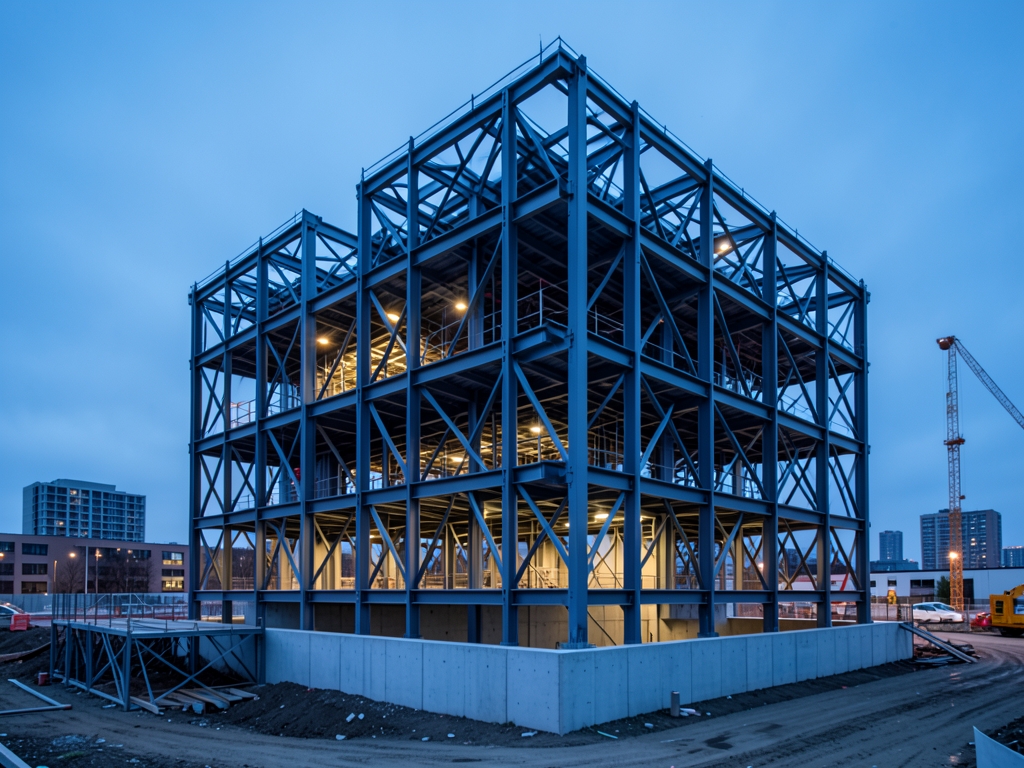
Confirm the drift mechanism first
Story drift ratio is defined for each story as δ/h: the relative lateral displacement between the floors bounding that story divided by the story height h used in the model. Compute it at every floor, not as roof displacement divided by building height. Roof displacement is cumulative and can mask a soft or weak story; a story-level δ/h check is what identifies where drift concentrates. Any comparison that mixes roof displacement with story drift should be rejected before beam sizes are discussed.
Before looking at beam sizes, name the controlling load combination and the seismic mass source. The 2.0% check is comparable only when the combination is the one in the adopted code or project criteria and the mass source is the one used to establish that criteria. If either is changed, substituted, or left unnamed, the resulting δ/h value is not a valid input to a beam-sizing decision.
P-Delta effects, accidental torsion, and diaphragm flexibility are branch conditions for this mechanism. If any one is omitted, the model is not representing the same lateral system, and the beam-size result cannot be treated as a verified drift-governed result. Each condition changes either the displacement demand or its distribution, so its absence can make drift appear lower than the model that includes it.
| Branch condition | If omitted | Effect on δ/h |
|---|---|---|
| P-Delta | Second-order amplification is not captured | Story drift can be understated |
| Accidental torsion | Torsional amplification is not captured | Drift can be understated at flexible edges |
| Diaphragm flexibility | Lateral force and displacement patterns are altered | δ/h may not represent actual story deformation |
With those items fixed, beam sizing can be tied to the drift-governed branch: size members for strength first, then reduce beams only while an independent model confirms that every story remains at or below the project-adopted 2.0% limit. The δ/h mechanism is the gate; it does not by itself select a final beam, but it determines whether a reduced beam can be accepted on drift grounds.
Keep the check story-specific and model-specific. A pass at one floor, under one combination, or in one model configuration does not extend to another floor, another combination, or a model with a different treatment of P-Delta, torsion, or diaphragm behavior.

Audit the evidence, not the headline
Accept a 2.0% drift result only when three separate evidence sources converge on the same gate: the adopted code limit and load combination, the site-specific hazard and mass source, and an independent peer model. Do not treat the 2.0% limit as a default target; verify it as a pass/fail condition before approving any beam reduction.
| Source | What must match | Acceptance test |
|---|---|---|
| Adopted code limit and load combination | Exact edition, table number, load combination, and any stricter authority-having-jurisdiction amendment | Points to the same 2.0% gate |
| Site-specific hazard and mass source | Same hazard and mass source used in the analysis model | No unresolved mismatch before acceptance |
| Independent peer model | Drift at base, mid-height, and roof checkpoints | All three checkpoints agree |
The first row is the adopted code limit and its load combination. Record the exact code edition, table number, and load combination used for the check. If the authority having jurisdiction has an amendment, use the stricter row; do not assume 2.0% without confirming the project-adopted value. The code row must state the limit actually adopted for the project, not a remembered or rounded value.
The second row is the site-specific hazard and mass source. It must be the same source used to establish the seismic demand and building mass in the analysis model. If the hazard or mass source differs from the model inputs, reconcile the difference before the drift result can be accepted. A mismatched source means the gate has not been verified, even if the reported drift is below 2.0%.
The third row is an independent peer model’s drift at the same checkpoints. Require agreement at base, mid-height, and roof; a single checkpoint that disagrees rejects the result. The peer model must use the same checkpoints and the same acceptance basis, but it must be independent enough to catch modeling or input errors in the primary analysis.
Acceptance is all-or-nothing: all three rows must point to the same 2.0% gate. If any row points to a different limit, load combination, hazard source, mass source, or checkpoint result, the 2.0% result is unverified and cannot govern beam sizing. Keep the convergence table in the project record so the audit trail shows why the gate was accepted or rejected.

Pick drift-governed or strength-governed
For this steel moment frame, the governing limit is not chosen by habit; it is chosen by evidence. Size beams for strength and constructability first, then treat the adopted drift limit as a verified pass/fail gate. Drift governs only if a code-matched model shows that reducing beams from the strength-sized section reaches that gate before strength or constructability limits are reached.
The three routes separate assumption from verification. Route A keeps strength-sized beams and changes nothing unless the model shows a failure. Route B sizes directly to the adopted limit, which makes the limit a design target rather than a checked result. Route C sizes for drift only after peer-checked P-Delta and torsion effects are included. Route C is the winner only when Route A fails the adopted limit; Route A wins when it already passes.
| Route | Starting beam size | Evidence required | When it wins |
|---|---|---|---|
| Route A | Strength-sized | Model shows the adopted drift limit is met | When strength-sized beams already pass |
| Route B | Drift-sized to the adopted limit | None beyond the target itself | Not preferred; a target alone is not evidence |
| Route C | Drift-sized with peer-checked P-Delta and torsion | Independent model confirms gate failure and checked effects | Only when Route A fails the adopted limit |
Reject the universal target. If the strength-sized section passes the adopted drift limit, any further beam reduction is a voluntary stiffness trade, not a drift requirement. Calling it drift-governed would misstate the reason for the smaller section and would hide a cost or constructability decision behind a compliance label.
The myth that drift always governs an eight-story steel frame fails at the same point. The killing number is not the story count; it is the model checkpoint where a strength-sized beam, or its first reduced successor, is shown to miss the adopted drift limit. Until that checkpoint is documented, drift has not governed beam sizing.
Apply the routing rule in one sentence: use verified drift-governed sizing only when an independent model confirms the gate failure and the required P-Delta and torsion checks are complete; otherwise retain strength-sized beams and record that drift did not govern. This keeps the adopted limit a gate, not a default.

Price tonnage and locate rule breaks
Price the tonnage before accepting a drift-governed reduction. The added steel from moving a beam from its strength size to its drift size is the sum, over every changed beam, of span length L in meters multiplied by the weight difference (w_drift − w_strength) in kg/m. That product is in kilograms; divide by 1,000 to express it in tonnes. Report this tonnage separately from connection redesign and from hours spent rechecking drift, because those costs follow different triggers and should not be buried in a single steel number.
Use the formula as a gate, not as a savings claim. A reduction is worth pricing only after the strength-sized section is fixed and the drift model is code-matched; if the model is not code-matched, the weight difference is not a reliable cost. Keep the calculation beam by beam, since a single average span or average weight can hide a long bay or a heavy section that dominates the total.
The 2.0% reduction rule is conditional. Break it—meaning stop using it to justify smaller beams—when any of the four checks below is missing or failed. Keep it only when all four are explicitly logged and passed.
| Required check | If missing or failed |
|---|---|
| P-Delta effects included | Do not reduce; rerun with P-Delta |
| Accidental torsion logged | Do not reduce; log and rerun |
| Diaphragm stiffness captured (rigid or explicitly flexible) | Do not reduce; model diaphragm stiffness |
| Adopted drift limit is the 2.0% gate being priced | Use the stricter adopted limit |
All four must be logged, not assumed. A note in the calculation set that says "P-Delta considered" is not the same as a model run with P-Delta active; the same applies to torsion and diaphragm assumptions. If any row fails, the reduction is unsupported even if the reported drift is below 2.0%.
The cost of being wrong runs in both directions. Over-sizing keeps steel in the frame that the drift check did not require, and it can mask a stiffness distribution problem if the extra weight is added where it does not reduce story drift. Under-sizing can leave a beam below the drift demand, so a later recheck or field change costs more than the steel saved. Price the tonnage, log the four checks, and let the verified gate decide whether the reduction survives.

Worked Example: Run the Numbers
This is one illustrative example only: a 2026 design check for an 8-story steel moment-frame in a high-seismic U.S. jurisdiction, with a project-adopted story-drift limit of 2.0%. No named project or party is identified; the scenario and year are fixed, while the arithmetic below shows method rather than a measured project result.
Run the check in this order. The table is an illustration of sequence, not a project record.
| Step | Action | Pass/fail rule |
|---|---|---|
| 1 | Start with the strength-sized beam section. | Baseline; drift reduction has not begun. |
| 2 | Reduce the beam by one available size. | Illustration only; candidate section for the next model run. |
| 3 | Run the code-matched model for the 8-story frame. | Use model output, not a hand estimate. |
| 4 | Extract the story drift ratio for each story. | Per-story value from the model. |
| 5 | Compute r_max across the 8 stories. | Single comparison value for the gate. |
| 6 | Compare r_max with 2.0%. | Pass if r_max ≤ 0.020; fail if r_max > 0.020. |
| 7 | On pass, repeat from step 2; on fail, retain the prior section. | Ends the reduction sequence at the break-even trigger. |
For each story from 1 through 8, take the model's story drift ratio r_i = δ_i/h_i, then compute r_max = max(r_1, ..., r_8). A reduced beam is accepted when r_max is at or below 0.020 and rejected when r_max is above 0.020. On acceptance, repeat the reduction from the new section; on rejection, keep the last accepted section as the design size.
For this example, the winner is the last beam size for which every story's model drift ratio remains at or below the 2.0% gate after a reduction. The break-even trigger is the next smaller size: the first reduction that makes r_max exceed 2.0%, or that consumes the remaining margin to the gate. That trigger ends the reduction sequence even if a smaller beam would still satisfy strength or constructability checks.
For the illustrative run, use the 2.0% value as the project-adopted gate; the pass/fail sequence above governs, and the model’s per-story output supplies the acceptance basis.

Run the audit and apply if/then rules
Run this audit on the project model, not on the illustrative numbers.
Before applying any conclusion below, replace the illustrative frame inputs with the project’s own geometry, loads, and code-matched analysis. Confirm the adopted drift limit and model assumptions against the project criteria rather than relying on the example values.
Use the model checkpoints to identify the last acceptable reduction: a smaller section is acceptable only if it remains at or below the adopted gate and also passes strength and P-Delta checks. Do not treat a near-gate pass as automatic permission to reduce further; verify with an independent model.
Apply these rules in order. (1) If the strength-sized beam drift is at or below the adopted gate, strength and constructability govern and no drift-driven reduction is justified. (2) If reducing beams crosses the adopted gate before strength or constructability limits are reached, drift governs and reduction stops at the last size with drift at or below the gate. (3) If a reduced size passes drift but fails strength, P-Delta, or constructability, retain the next larger size that passes all checks. (4) If any model input differs from the project criteria, rerun the audit with project values before applying a rule. (5) If the margin to the gate is small enough that model uncertainty could change the pass/fail result, require independent model confirmation before accepting the reduction.
Use the audit as a pass/fail gate for the specific model run, not as a default target for the project. A size that passes drift in this example can still fail another check, and a size that fails here may be acceptable only after the model, loads, or detailing change.
Frequently Asked Questions
What sizing sequence does the guide set for beam sizing in a 2026 8-story steel moment-frame?
This guide sets a strength-first sequence for beam sizing in a 2026 8-story steel moment-frame.
How should the 2.0% story-drift limit be treated during beam sizing?
Treat the 2.0% story-drift limit as a verified pass/fail gate; do not size beams to 2.0% by default.
When should the 2.0% check govern beam sizing?
The 2.0% check should govern beam sizing only if a code-matched model shows the 2.0% gate is reached before strength or constructability limits when beams are reduced from strength-sized sizes.
What must an independent model confirm while beams are reduced from strength-sized sections?
When reducing beams from strength-sized sections, continue only while an independent model confirms drift stays at or below the project-adopted 2.0% limit.
How is story drift ratio defined for each story?
Story drift ratio is defined for each story as δ/h: the relative lateral displacement between the floors bounding that story divided by the story height h used in the model.
How should story drift be computed instead of using roof displacement divided by building height?
Compute it at every floor, not as roof displacement divided by building height.
Quick answers
| What sizing sequence does the guide set for beam sizing? | It sets a strength-first sequence for beam sizing in a 2026 8-story steel moment-frame. |
| How should the 2.0% story-drift limit be treated? | It should be treated as a verified pass/fail gate, not a default target. |
| When should the 2.0% check govern beam sizing? | Only if a code-matched model shows the 2.0% gate is reached before strength or constructability limits when beams are reduced from strength-sized sizes. |
| What condition must hold when reducing beams from strength-sized sections? | Continue only while an independent model confirms drift stays at or below the project-adopted 2.0% limit. |
| How is story drift ratio defined and computed? | It is defined for each story as δ/h, the relative lateral displacement between the floors bounding that story divided by the story height h used in the model, and it should be computed at every floor rather than as roof displacement divided by building height. |
Also worth reading: 020hsx vs 0.035hsx: ASCE 7-22 and ASCE 41-22 Drift Limits: 020hsx vs 0.035hsx: ASCE 7-22 · Steel frame weight cut: 30% steel saving fails pushover validation: Steel frame weight cut: 30% · ASCE's 2024 Infrastructure Report Card Data-Driven Analysis of America's Aging Bridge Network: ASCE's 2024 Infrastructure Report Card