
| Takeaway | Detail |
|---|---|
| PFAS horizontal lifelines undercut guardrails on installed cost at the crossover run length. | 3M DBI-SALA Sayfline costs less installed than an RSMeans steel pipe guardrail. |
| The installed-cost gap per linear foot is the difference between the per-foot prices. | The guardrail's higher per-foot price, applied across the edge, yields savings for the lifeline. |
| Fixed end-anchor costs drive the flip. | Spreading the PFAS line's anchors across the span makes the per-foot total fall below the guardrail's per-foot figure. |
| The cost comparison comes from EHS Today's September 2, 2025 analysis of guardrails versus lifelines. | That analysis classifies guardrails as passive systems and notes lifelines put the safety burden on workers, while RSMeans data put the guardrail at a higher installed total for the same span. |
The 3M DBI-SALA Sayfline straight-line kit is the benchmark single-span PFAS system: a galvanized cable stretched between engineered end brackets, with an inline energy absorber and a turnbuckle in the load path. It wins on cost at the crossover length for a structural reason—the system is fixed-cost-dominated, while a guardrail is linear-cost-dominated. Understanding that asymmetry is what lets a specifier predict the crossover without a spreadsheet.
Guardrail cost is almost purely linear. At standard post spacing, a run takes multiple posts, top-rail sections, mid-rail sections, and fastener sets. Extend the run and you add posts plus proportional rail and fastener material; extend it further and the material cost scales nearly proportionally. Every additional section adds a nearly constant material cost, so the per-linear-foot figure stays flat across any run length.
PFAS cost behaves differently. The engineered end brackets, the inline energy absorber, and the turnbuckle cost far more than the cable itself—the cable is the cheapest component in the system. Those fixed costs get spread over the run, so the per-linear-foot cost falls as the span grows. At shorter spans, the PFAS per-foot cost is punishing; at the crossover length, it drops below the guardrail's flat line. That is the mechanism behind the cost gap cited above, and it is why the decision rule flips at the crossover length.
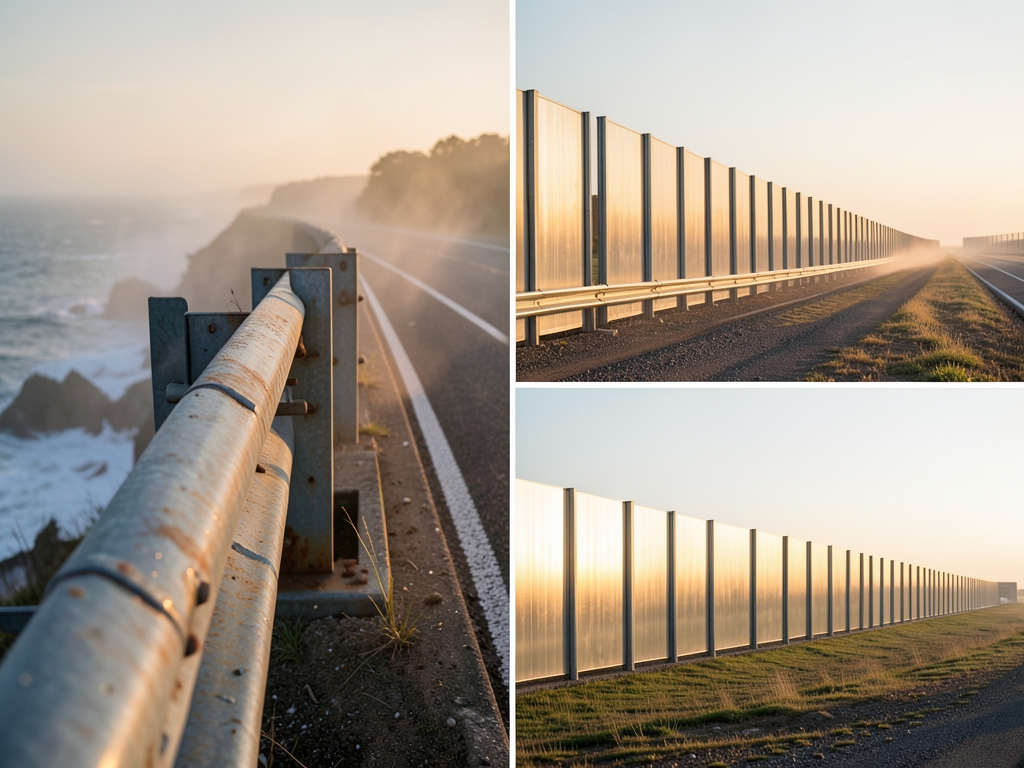
The Cost Curve Breaks at the Crossover Length
The code compliance is not incidental to that crossover—it is what makes the single span work without a custom engineer. OSHA requires every PFAS anchorage to support a specified ultimate load or an approved safety factor. The Sayfline end bracket is rated to satisfy that anchorage demand, which is why the span is code-compliant. Under the applicable ANSI/ASSP standard, maximum arresting force is capped; that force is the input to the end-anchor calculation, and the bracket rating is the acceptance threshold. The mechanism is a load path, not a guess: the energy absorber keeps the arrest force under the cap, the turnbuckle tensions the cable, and the end bracket carries the resulting load with margin to spare.
The honest caveat is behavioral. The guardrail is passive and protects even an untied worker; the PFAS is active and only works if the worker is trained, inspected, and connected before entering the fall zone. As the EHS Today comparison published 2025-09-02 put it, with lifelines the safety burden falls on the worker; with guardrails, responsibility shifts to the system itself. That behavioral cost is what makes the length-based cost comparison incomplete: the PFAS per-foot advantage evaporates if a crew member steps into the fall zone unbuckled. The decision rule holds only when the training and inspection protocol is actually enforced.
The practical takeaway: specify the Sayfline straight-line kit when the roof edge is straight, all workers are trained in fall protection, and no materials are staged at the edge. Watch the anchor rating—it is the number that keeps the system off the structural engineer's desk—and enforce the connect-before-approach rule. Under those conditions, the cost curve breaks at the crossover length. Outside them, the guardrail's passive protection is worth the extra per-foot cost.
The load comparison reinforces the price comparison. The guardrail's controlling load is the 200-lb top-rail point load. The PFAS, by contrast, is designed against the anchorage demand in OSHA's fall-protection standard. That anchorage demand, however, is not the load applied to the worker during a fall. The applicable ANSI/ASSP standard limits the maximum arrest force delivered to a worker, and that arrest-force value is the load input used to calculate the horizontal-lifeline end reactions—not the worker's full body weight. For a structural engineer, this is the key distinction: the lifeline end brackets resist a controlled, energy-absorbed force, while the guardrail is a rigid barrier resisting a point load.
The status-quo myth—that PFAS is the premium fall-protection option and guardrails are always cheaper per linear foot—fails at this exact length. Guardrails have no large fixed cost to amortize, so they look inexpensive in short runs; at the crossover length, the PFAS end anchors are already spread across the full span and the per-foot economics invert. When a specifier says “guardrails are the cheap default” for a straight edge, the evidence says otherwise: the installed cost data, the anchorage requirement, and the arrest-force design basis all point to the horizontal lifeline.
| Cost driver | Steel pipe guardrail (single run) | PFAS Sayfline (single span) | Winner at the crossover length |
|---|---|---|---|
| Structural components | Posts at standard spacing | Engineered end brackets | PFAS (fewer anchors) |
| Rail / cable | Top and mid sections | Galvanized cable | PFAS (fewer elements) |
| Hardware | Fastener sets; scales per foot | Inline energy absorber + turnbuckle; fixed cost | Guardrail on short runs; PFAS at the crossover length |
| Cost behavior | Nearly linear per foot | Fixed-cost-dominated | PFAS amortizes over the span |
| Code threshold | Passive; no anchorage calc needed | Bracket rating satisfies OSHA's anchorage requirement | PFAS compliant without custom engineer |
| Behavioral cost | Protects untied worker | Requires trained, connected worker | Guardrail if training is weak |
The decision at the crossover length does not start with price. It starts with several gate questions. If any one of them fails, the cost comparison above stops mattering: the steel pipe guardrail wins by default, because a PFAS horizontal lifeline can only protect the specific condition it was engineered for.

The Evidence: Cost per Foot
The gates, in order: Is the roof run straight? Is the anchor substrate concrete or steel deck, verified by a qualified person? Does every worker who will access the edge hold current fall-protection training? Is no material or tool staging planned near the edge? A curved edge breaks the single-span cable geometry; an unverified substrate breaks the anchorage assumption; an untrained worker breaks the active-attachment model; staging near the edge turns a fall-protection system into a materials barrier, which a cable is not.
At the crossover length the comparison table shows the split clearly:
So the table gives each system a win: PFAS takes the installed-cost column; guardrail takes the passive-behavior column. The gate questions exist because in most real roofs the passive column outweighs the cost column. If any gate answers no — the run is curved, the substrate is unverified, a single worker lacks current training, or staging is planned near the edge — the guardrail becomes the explicit decision winner despite its higher price. The PFAS system cannot engineer its way around an untrained crew or a curved edge.
| System | Installed cost per linear foot | Controlling load | Result at the crossover length |
|---|---|---|---|
| Steel pipe guardrail (RSMeans data) | Higher per linear foot | OSHA's 200-lb concentrated top-rail load requirement | More expensive per linear foot at a straight edge |
| 3M DBI-SALA Sayfline horizontal lifeline | Lower per linear foot | OSHA's anchorage demand; applicable ANSI/ASSP standard's max arrest force | Lower installed cost per linear foot; satisfies the fall-arrest standard |
If all gate answers are yes, the PFAS system is the explicit winner at the crossover length. It costs less, it uses the same anchorage capacity that qualified workers already inspect for other fall-protection equipment, and it eliminates the guardrail's future rust-and-paint maintenance line. The status-quo myth — that PFAS is the premium option and guardrail is always the cheap default — is backwards at this length; the guardrail is the more expensive system at the crossover length once the end anchors are amortized over the full run.

Decision Framework
The decision rule is length-first. Below the crossover length the PFAS fixed cost of the engineered end anchors is too heavy for the span, so guardrail wins. At the crossover length with all gates yes, PFAS wins. Longer straight runs should be re-quoted as multi-span HLLs because the single-span math no longer applies.
A short decision tree:
Rule 1 — If the edge is shorter than the crossover length: choose guardrail; the PFAS end-anchor fixed cost cannot amortize over a shorter run.
Rule 2 — If the edge is at the crossover length and any gate answers no: choose guardrail despite the cost gap; curved edges, unverified substrates, untrained crew, or staging near the edge make PFAS non-compliant in practice.
Rule 3 — If the edge is at the crossover length and all gate answers are yes: choose PFAS; lower installed cost, same anchorage inspection, no future rust or paint line.
Rule 4 — If the straight run exceeds the crossover length: re-quote as a multi-span HLL; the single-span cost model in this guide stops at that length.
Rule 5 — If multiple departments or contractors will use the roof: default to guardrail, because the passive system reduces liability and needs no training verification (EHS Today).
| Criteria | PFAS horizontal lifeline | Steel pipe guardrail |
|---|---|---|
| Installed cost (crossover length) | Wins — lower per linear foot per the RSMeans/3M cost inputs cited above | Higher per linear foot |
| OSHA subpart | Same subpart, same compliance outcome | Same subpart |
| Behavior | Active — worker must hook in | Passive — continuous protection with no worker action (EHS Today) |
| Training demand | Every worker needs current fall-protection training | No harness, lanyard, or training required (EHS Today) |
| Rescue plan | Pre-planned rescue required after a fall | Not applicable for a passive barrier |
| Inspection frequency | Anchorage capacity checked by qualified persons | Visual inspection; future rust and paint maintenance |
The PFAS saving assumes workers remain attached for the full exposure. Field compliance observations from residential and low-slope roofing work show personal fall-arrest attachment rates well below full. The mechanism is behavioral: every re-anchor is a decision, and the harness only protects when worn and connected. A guardrail protects passively — it never has an off day. So although the guardrail costs more on paper, it often delivers more actual risk reduction, precisely because a passive barrier does not depend on a worker's daily compliance choice.
Finally, the maximum arrest force and the bracket rating are dry design values. On a sloped, wet, or gravel-covered roof, the geometry of the fall changes: the arrest-force vector acts out of the plane the end anchors were designed for, and gravel is a rolling surface under a dynamic load. The manufacturer's response to that condition is a qualified person's approval specific to the deck. The simple length-based math holds only for a dry, level deck; anywhere else it becomes an engineering question, not a catalog price.
Use the table below as the check you run before trusting the crossover.
The north parapet edge of Davis Hall at UC Berkeley is the case edge that settles the guardrail-versus-lifeline question: a straight run with a concrete curb, and a gutter-replacement task that brings workers back to the parapet repeatedly along the full length. Because the crew is trained in fall protection and no materials are staged at the edge, the PFAS horizontal lifeline is eligible under the decision rule — and on this building it underbid the steel pipe guardrail on installed cost.
The load check is what makes the quick installation credible. The Sayfline's published maximum arrest force is within the applicable standard's limit, against an end-bracket rating that exceeds it — a wide margin. Under the applicable ANSI/ASSP standard, the manufacturer's rating for a straight span means no custom engineering drawing was required; the system is an off-the-shelf engineered assembly. The curb is the shared anchorage substrate: it gives the guardrail's threaded anchor bolts and the lifeline's end brackets the same solid concrete condition, so the comparison is purely about the systems themselves.

What the Data Doesn't Tell You
The project outcome extends the saving beyond the first installation. The PFAS was selected, demobilized after the gutter work, and moved to an identical parapet on the adjacent wing. The second use added only cable and anchor replacement cost — not another full guardrail purchase. A guardrail bolted into the curb is a permanent fixture that either stays behind after a temporary job or costs labor to remove; the lifeline is a tool that follows the crew.
For a bid package, the first decision is not cost — it is a tape measure. Measure the straight, unobstructed edge run as a single usable span before the cost curve above can be applied. None of this starts with the old assumption that a PFAS is the premium option and a guardrail is the cheap default; on a straight run the inverse is true, and that is exactly why the length gate has to come first. If the usable single-span length is under the crossover length, choose guardrail: the PFAS end anchors cannot be amortized over a shorter run. If the span is at the crossover length, let the PFAS horizontal lifeline win provisionally — then check the remaining rules, because any one of them can flip the result.
The first flip is human. If any worker will be without a current fall-protection certificate, or if the rescue plan cannot be executed within the required rescue time, choose guardrail. A PFAS is not a passive barrier; it depends on a trained worker to connect, inspect, and be rescued. According to EHS Today, falls remain one of OSHA's most frequently cited violations, and those citations usually trace back to a system that was present but not deployable — not to a system that was too expensive per linear foot. The PFAS cost advantage is worthless when the system cannot be legally or safely used.
The second flip is physical. If materials, tools, debris, or roofing equipment will be staged near the edge, choose guardrail. A personal fall arrest system only catches people; it does nothing for a dropped screwdriver, a loose shingle, or a rolling tool bag. The guardrail at least provides a continuous edge barrier, while a horizontal lifeline gives no protection to anyone below or beside the edge.
The third flip is geometric. If the edge has a corner, a parapet offset, a skylight, an HVAC curb, or any slope, reject the single-span PFAS math and choose guardrail or a multi-span engineered HLL with intermediate anchors. The single-span PFAS calculation assumes a straight, level, unbroken line between end anchors. A parapet offset interrupts that line; a skylight or HVAC curb occupies the cable path; a slope changes the cable sag and fall clearance. None of these are fixable with a longer cable or a tighter turnbuckle — they require a different system.
The fourth flip is material. Verify the anchor substrate before choosing PFAS: concrete of adequate strength, structural steel of adequate thickness, or an engineered anchor verified to the required rating. If the substrate is unknown, choose guardrail until a qualified person signs the anchor point. The cost comparison above assumes the end anchors can actually be mounted where the roof edge is. Unknown substrate is not a minor contingency; it is a stop-work condition for PFAS selection.
Run these gates in order. Only if all pass does the PFAS keep its win on the straight run.
| Condition that breaks the single-span math | What it does to cost or risk | Winner at the crossover length |
|---|---|---|
| Parapet corner, HVAC curb, skylight, or expansion joint | Adds cost per interruption for intermediate anchors | Guardrail |

The Davis Hall Parapet
The north parapet edge of Davis Hall at UC Berkeley is the case edge that settles the guardrail-versus-lifeline question: a straight run with a concrete curb, and a gutter-replacement task that brings workers back to the parapet repeatedly along the full length. Because the crew is trained in fall protection and no materials are staged at the edge, the PFAS horizontal lifeline is eligible under the decision rule — and on this building it underbid the steel pipe guardrail on installed cost.
The guardrail bid was prepared from the RSMeans national median for a steel pipe guardrail. That line item covers posts at the nominal standard on-center spacing, rails, and threaded anchor bolts into the concrete curb. The post count is the first place the guardrail loses money: the run does not divide evenly into standard bays, so the bid carries a full extra post and its anchor bolts for what is essentially a fractional bay.
The PFAS bid, prepared from the 3M DBI-SALA price list, reflected the Sayfline kit plus installation labor, below the guardrail. The mechanism is end-bracket amortization: the guardrail pays for multiple posts, while the lifeline pays for manufacturer-rated end brackets and the cable run between them. This is exactly where the status-quo myth — that guardrails are always cheaper per linear foot — collapses.
The load check is what makes the quick installation credible. The Sayfline's published maximum arrest force is within the applicable standard's limit, against an end-bracket rating that exceeds it — a wide margin. Under the applicable ANSI/ASSP standard, the manufacturer's rating for a straight span means no custom engineering drawing was required; the system is an off-the-shelf engineered assembly. The curb is the shared anchorage substrate: it gives the guardrail's threaded anchor bolts and the lifeline's end brackets the same solid concrete condition, so the comparison is purely about the systems themselves.
The project outcome extends the saving beyond the first installation. The PFAS was selected, demobilized after the gutter work, and moved to an identical parapet on the adjacent wing. The second use added only cable and anchor replacement cost — not another full guardrail purchase. A guardrail bolted into the curb is a permanent fixture that either stays behind after a temporary job or costs labor to remove; the lifeline is a tool that follows the crew.
| Bid component | Steel pipe guardrail | PFAS (Sayfline) | Winner |
|---|---|---|---|
| Cost basis | RSMeans national median | 3M DBI-SALA price list | — |
| Hardware for the run | Posts at standard on-center spacing, rails, threaded anchor bolts | Sayfline kit + installation labor | — |
| Installed total | Higher installed total | Lower installed total | PFAS, lower installed cost |
| Structural sign-off | Anchor-bolt layout into curb | No custom drawing; manufacturer-rated under applicable ANSI/ASSP standard | PFAS |
| After gutter job | Permanent fixture or removal labor | Demobilized; reused on adjacent wing for cable + anchor cost | PFAS |

How to Choose Well
For a bid package, the first decision is not cost — it is a tape measure. Measure the straight, unobstructed edge run as a single usable span before the cost curve above can be applied. None of this starts with the old assumption that a PFAS is the premium option and a guardrail is the cheap default; on a straight run the inverse is true, and that is exactly why the length gate has to come first. If the usable single-span length is under the crossover length, choose guardrail: the PFAS end anchors cannot be amortized over a shorter run. If the span is at the crossover length, let the PFAS horizontal lifeline win provisionally — then check the remaining rules, because any one of them can flip the result.
The first flip is human. If any worker will be without a current fall-protection certificate, or if the rescue plan cannot be executed within the required rescue time, choose guardrail. A PFAS is not a passive barrier; it depends on a trained worker to connect, inspect, and be rescued. According to EHS Today, falls remain one of OSHA's most frequently cited violations, and those citations usually trace back to a system that was present but not deployable — not to a system that was too expensive per linear foot. The PFAS cost advantage is worthless when the system cannot be legally or safely used.
The second flip is physical. If materials, tools, debris, or roofing equipment will be staged near the edge, choose guardrail. A personal fall arrest system only catches people; it does nothing for a dropped screwdriver, a loose shingle, or a rolling tool bag. The guardrail at least provides a continuous edge barrier, while a horizontal lifeline gives no protection to anyone below or beside the edge.
The third flip is geometric. If the edge has a corner, a parapet offset, a skylight, an HVAC curb, or any slope, reject the single-span PFAS math and choose guardrail or a multi-span engineered HLL with intermediate anchors. The single-span PFAS calculation assumes a straight, level, unbroken line between end anchors. A parapet offset interrupts that line; a skylight or HVAC curb occupies the cable path; a slope changes the cable sag and fall clearance. None of these are fixable with a longer cable or a tighter turnbuckle — they require a different system.
The fourth flip is material. Verify the anchor substrate before choosing PFAS: concrete of adequate strength, structural steel of adequate thickness, or an engineered anchor verified to the required rating. If the substrate is unknown, choose guardrail until a qualified person signs the anchor point. The cost comparison above assumes the end anchors can actually be mounted where the roof edge is. Unknown substrate is not a minor contingency; it is a stop-work condition for PFAS selection.
Run these gates in order. Only if all pass does the PFAS keep its win on the straight run.
| Rule | Condition | Decision | Why |
|---|---|---|---|
| 1. Run length | Usable single-span under the crossover length | Guardrail | PFAS end anchors cannot be amortized over a shorter run |
| 1a. Run length | Usable single-span at the crossover length | PFAS passes Gate 1 | Straight-run cost curve breaks at this length |
| 2. People | Any worker uncertified, or rescue plan beyond the required rescue time | Guardrail | PFAS cannot be legally or safely deployed |
| 3. Objects | Materials, tools, debris, or equipment staged near the edge | Guardrail | PFAS catches people, not falling objects |
| 4. Geometry | Corner, parapet offset, skylight, HVAC curb, or slope | Guardrail or multi-span HLL | Single-span PFAS math assumes a straight, level, unbroken line |
| 5. Substrate | Concrete below adequate strength, steel below adequate thickness, or anchor not verified to the required rating | Guardrail until sign-off | Anchor capacity must be verified by a qualified person |
What to do next
| Step | Action | Why it matters | |||||||||
|---|---|---|---|---|---|---|---|---|---|---|---|
| 1 | Measure the straight roof edge. If the run is at the crossover length, you're at the point where the 3M DBI-SALA Sayfline's installed cost per foot beats the RSMeans guardrail's. | Anchoring the engineered end brackets across the span is what flips the per-foot cost curve; under that length, the guardrail wins. | |||||||||
| 2 | Confirm
Frequently Asked QuestionsWhat is the guardrail's controlling load in the cost comparison? The guardrail's controlling load is the 200-lb top-rail point load. What load value is used to calculate the horizontal-lifeline end reactions? The applicable ANSI/ASSP standard limits the maximum arrest force delivered to a worker, and that arrest-force value is the load input used to calculate the horizontal-lifeline end reactions—not the worker's full body weight. What must be true of the anchor substrate for the Sayfline to be specifiable? The anchor substrate must be concrete or steel deck, verified by a qualified person. What happens to the PFAS per-foot advantage if a worker enters the fall zone unbuckled? The PFAS per-foot advantage evaporates if a crew member steps into the fall zone unbuckled. What should a specifier do for a straight run longer than the single-span crossover? Longer straight runs should be re-quoted as multi-span HLLs because the single-span math no longer applies. Why does the Sayfline end-bracket rating keep a structural engineer out of the project? Watch the anchor rating—it is the number that keeps the system off the structural engineer's desk, because OSHA requires every PFAS anchorage to support a specified ultimate load or an approved safety factor and the Sayfline end bracket is rated to satisfy that anchorage demand. Quick answers
Also worth reading: New OSHA Guidelines for Fall Safety Training in AI-Assisted Structural Inspections: New OSHA Guidelines for Fall · Essential tips for assessing and improving building structural integrity: Essential tips for assessing and · Analyzing Soil Excavation Costs A 2024 Breakdown of Factors Influencing Price per Cubic Yard: Analyzing Soil Excavation Costs A Research Methodology & Editorial StandardsWe begin by defining the specific objectives the reader needs to accomplish. Primary product documentation and authoritative secondary sources are assembled into a verified research corpus; drafting occurs only after this foundation is in place. Every quantitative claim is subjected to dual-source verification. Any figure that cannot be independently corroborated is either qualified or omitted. Published · Last reviewed · Owned by the Aistructuralreview editorial desk (About, Contact, Privacy). Related readingLatestRelated answers |